Showing posts with label negotiation. Show all posts

Saturday, 15 November 2014

On becoming two


I have been thinking for a while about a way to introduce my wonderful teaching partner, ECE Pooneh Haghjoo. This year has been fast-paced and action-packed, much more than any year since perhaps my first year of teaching (hence a long time since my last post). Although in some ways this year has been the most difficult in memory, with issues and events popping up to complicate the usually busy but joyous job of teaching, I've had many moments of looking over at my partner and thinking: "How did I get so lucky?" Transitioning to FDK has come with many challenges, and not the parts that I anticipated being difficult: the project-based learning from following children's inquiries that our school board and our Ontario curriculum document support is a big part of our K team's culture. Learning to work around sharing the yard throughout the day with 3 other classes and more planning times to consider, more kids/less materials/equipment/space with large classes, among other items on the learning curve. Not difficult this year: finding a way to share the space I'd made my home over the last two years. I'd been told it can be something like a marriage, in that two people share intimate quarters, materials, kids and important responsibilities. I imagined I would be hard to work with: I'm always making plans based on kids' interests and questions, then throwing those plans (and assembled materials/provocations) away or aside when a more powerful learning experience comes up. I've so many loose threads on the go, like my browser which always has at least 5 tabs open... I'm not the calm, quiet one in the room. I'm excited about life and learning. I'm passionate about the environment as third teacher and learner collaboration as the key to inquiry. I'm also loud, often provoking students with musical or noisy invitations to play. I'm happier outside than in, especially because I believe I see the true personality of children when all of their senses are fully engaged in learning, which is much more possible outdoors in every season.

Over the summer I engaged in losing myself in the big, beautiful outdoors with my family. The growth in my kids, especially over our 2 weeks visiting family and friends in BC (shared in this earlier post), was incredible to me. So it was with some trepidation that I returned to school where we were entering our first year of FDK and me not knowing my partner's name or anything about him or her.

In some ways, it was not unlike moving schools like I did three years ago when I left RJ Lee PS in the north after eight years in the same spacious Kindergarten classroom. My commute was a long one but it was hard to leave a community, both my colleagues and the families of students, some of whom had two and three siblings join my class over my time there. I fell in love with the people, but also fell in love with the tree-lined creek that snaked past the school on our north boundary. Walks along the path were "trips to the jungle" and "forest adventures" to my students. We saw cotton-tail rabbits, geese and mallards aplenty, and even a pair of wood ducks one summer day. We went often to "visit our ducklings" every spring. And watched them grow from fuzzy yellow balls that "peep!" through the awkward fuzz and feather stage, always running after "mama duck". We peeked at the school through breaks in the leaf cover, and felt like no one could see us. Leaving RJ Lee was difficult for all the reasons mentioned above, but for me, having grown up in the countryside with a swimming pond and forests to wander in, leaving the little piece of wild behind was really hard. I couldn't imagine finding anything like it anywhere again.

It's not that different for our students, coming to our classes as their first experience of school. What will it be like? Will I make friends? Will it be safe? Will I have fun? Will I know what to do? Moving to Thornwood PS, I was delighted to discovery it was bordered by Cooksville Creek, and that it has the unique "no-mow zone" wild learning area just across the field from our classroom windows (described in this post). Likewise, while I was eagerly anticipating finally joining FDK, I was full of doubts and questions. Last year I had asked Tessa Heffernan, (a PLN friend whose outlook on the learner as capable always shines through in her writing) if she would share what makes her partership with Holly Diljee such a rich and rewarding relationship for the both of them. I was so touched by the obvious love and respect in the post, and it both inspired and worried me. How likely was it for me to be placed with someone who I could see eye-to-eye with on daily matters and big ideas? Tessa's words below, taken from her guest post (see here) really summed up what I had found with the OCT team at Thornwood over the last year, and what I really hoped would be possible with our new ECE partners.
A Joint Philosophy
I’m going to be honest and say that we simply lucked out when it came to similar philosophies.  We both are huge proponents of open-ended materials and activities, uncovering the curriculum through play, emergent learning, a natural and warm environment, choice, supporting and promoting self-regulation, building relationships and teaching skills as opposed to discipline, and making developmentally appropriate decisions.  These goals allow us to constantly focus on the ‘why’ behind our decisions.  If a school-wide activity comes up, we make a decision about participation based on our philosophy.  If we are considering a provocation or activity, we think about how it fits or does not fit with our programming.  If children are taking part in an “outside of the box” exploration, we generally ask ourselves two questions:  1. Are the children being safe?  2.  Are the materials being respected?

It's hard to believe now, only a few months in to our time sharing a classroom, but I feel like Tessa's words ring true for me in so many ways. Pooneh has a wealth of experience as a teacher first (back in Iran) but also ECE experience in Canada with early years teaching, mostly with toddlers. Her obvious love of the students is clear to all: our parents, students, and all staff at Thornwood. Her way of reading students' body language and participation to know when it's time to change our routine, our set-up or even simply the story being read aloud? She is a consummate teacher, always listening carefully to the students, looking closely for themes emerging that she can extend. She is patient with young students who say: "I can't" even when they very likely can. She is as fascinated with the way kids think (including their interesting wrong conclusions to experiences) as I am, which belies a powerful belief in kids as capable learners with gifts and ideas of their own. She is patient with allowing students to struggle when it will lead to greater understanding, but also willing to help when a tired child is past their ability to persevere. In short, Pooneh embodies the model of scaffolding learning in her approach to teaching. I wound up with a partner as solidly convinced about the rightness of emergent curriculum as I am.

Her sense of humour lifts me when I'm frustrated with some mundane issue after a busy day. Her joyful embrace of experiential learning, the aspect of a partner I was most worried about? It shines through in her words, actions, and daily documentation of our students learning together. At first I wasn't sure how to add a second user to our class twitter page, so I would simply retweet her posts onto our class page (as some of those I've included here). Now that we share the account as authors, I find myself looking at our page and grinning when I see a new post of a moment I witnessed from across the room (while I was engaged with other students) or often not present for (while one of us takes a group for walks as the other teacher remains in the kindergarten yard with students using outdoor equipment). I appreciate how she sees the growth of individual children as well as the bigger ideas unfolding in their play within groups. It makes me think of how rich our reports and interviews will be, looking at the wealth of observation and documentation she brings. I love the way she captures the joy on the students' faces: though we obscure faces to protect student privacy, the grins are evident in photos of experiences inside and out of the classroom. I also grin when I see a post "faved" by our own account, knowing Pooneh has just come across something I shared that she finds delightful.

Below are just a sampling of tweets that show the joyful learning that my partner has captured this year.
September 17th was "International Flip a Rock Day" and I knew whatever else came our way, I had a partner who saw the value of free exploration outdoors. 

"Look Closely" truly became the culture of my classroom last year when I was still 1/2 day (and thus no teaching partner at the time). It was obvious pretty quickly that Pooneh sees the magic in the littlest moments, too.

The above tweet shows one of Pooneh's many projects undertaken to answer a question or spark from one of the children. It may have grown out of this noticing by several children much earlier on. (tweet below).

One of Pooneh's many invitations for students to explore materials using their senses.

 No explanation (of above tweet) necessary.


Pooneh and the kids playing under the oaks.
 Moments of exploration that resonate for me with the
inquiry-learning approach as outlined in "Worms,
Shadows and Whirlpools".

Earlier week, Pooneh brought a child-sized table and chairs for the classroom, and yesterday she invited students to help her wash it and restore the loose trim with glue. A group of students jumped at the chance to help. I missed almost all of it as they were working away in the cubby area while I was working with others in the classroom, in particular capturing moments at the ice inquiry table we'd set up near the windows. Later that day I smiled when I saw this:

I captured these four girls playing with Pooneh in the cubby while waiting to be picked up at the end of the day: "We are drumming on the table that we worked so hard to clean" say JP and EW (click for vine clip).

Another delightful moment in the day occured during our long "Play & Learn" block in the morning. Students playing with the medical tools from the class "Veterinary Kit" decided to take care of Pooneh instead of animals or other student patients. I wonder now if it was because of the morning conversation at welcome circle when she shared she wasn't fond of the cold weather. She waved at me, holding her "prescription" from one girl: a trip to the beach was the doctor's order. More prescriptions followed.
I know that our story has just begun, and that much learning will occur before the year is over. I have much to learn from my partner and it is still early enough in the year that we continue to tweak our schedule and environment in order to meet our students' learning needs... but I am confident that from now on, classroom stories will be "our stories". I am extremely grateful for my partner. From there, much is possible.

Addendum: when I see the way all the Kindergarten classes have grown over the last few quick months, I'm truly pleased that our new ECE partners are equally on board with the adventure of child-lead, play-based learning as our OCT team are. I often fave tweets from both ECEs and class accounts (some are sharing account like Pooneh and I now do, other classes retweeting from ECE as we did) and I'm delighted at the rich conversations taking place between classes and over lunch in the staff room. Though our school experienced a painful loss this fall that touched us all (deeply felt in Kindergarten), our team is so full of passionate teacher/learners that I expect we'll continue to meet all challenges as a family. I feel incredibly fortunate to work with my Thornwood PS colleagues.

Nothing without Joy - Loris Malaguzzi


Saturday, 16 August 2014

musings on what really matters, from a valued friend

I don't wish to take much space here because the beauty of Tessa's post is perfect in its entirety. I do, however, want to share how it came to be I was able to bring this unique voice here. There are many people with whom I've made a connection online (through #ReggioPLC twitter chats or spontaneous conversations) that goes beyond "twitter follower/PLN". There is something about the way we share a view of children (as infinitely capable, curious, fascinating) and teaching (as a wondrous journey, forever deepening and growing out into our lives) that creates real friends through the ether. So naturally, when there is a chance to meet these inspirations in "real life", I jump at it. Tessa and Holly came to Toronto for an Ontario Reggio Association conference in the spring, and though I was unable to attend I was not going to let the chance to break bread go by. We wound up having quite the emergent curriculum model walking tour of downtown Toronto (that was my fault, imagine a toddler taking you for a tour: smells, sights, sounds all stop me in my tracks constantly). When we finally sat down for a cuppa, I felt like these two wonderful educators were long-lost friends. It was an interesting coincidence that Tessa sent me her draft during the week of the second annual "Reggio-inspired Summer Intensive" course where many of us thought about the #ReggioPLC voices we were missing, such as Tessa, Tracy, Nancy, and many others. Teaching through the lens of joy, discovery, curiosity and possibility does make life and friendship seem so rich. 
What follows is Tessa's story, with all photos by Tessa or Holly.


A Teaching Partner Forever Changes You

I was thrilled when Laurel asked me to write a post for her blog...ten months ago!  In true Laurel fashion, she gave me complete free reign over what to write and I mulled over a variety of topics as I worked my way through my first year in Full Day Kindergarten.  After the year was finished, I thought it would be the perfect chance to share some of our learning.  But as I wrote what I thought was going to be an overview, one element continued to stand out:  the educator team in FDK.  Within everything I wrote emerged the experience of working, collaborating, and dreaming with a teaching partner and so here I share with you our journey.

Words could never fully capture the impact of teaching alongside a partner and, more specifically, with Holly Diljee.  Let’s be honest here - there is a period of time before beginning the journey with a teaching partner of extreme trepidation.  Will my partner be okay with my spontaneous nature and habit of making regular changes to plans throughout the day?  Will I feel like a fool doing my typical singing/dancing routines in front of another adult?  Will our philosophies be similar?  What if we disagree about things?  How will we know who does what throughout the day?  But all of this trepidation is now a distant memory.

Holly reading a story outdoors.

Planning & Creating Our Environment Together

I knew things would be amazing in the first email I received from Holly.  I was fairly certain we would be a great match.  And then we began working together and I felt beyond fortunate that our paths had met up.  I think the first time I realized what an impact Holly was going to have on my teaching was when we sat down together to plan out our room.  She had such innovative ideas and considered elements that I had not thought of before.  She suggested that we put our dramatic play centre in the middle of the room to act as a divider and, through conversation, we realized it also sent a very strong message about what we valued in our classroom.  I wanted our couch to be within eyeshot when entering the room to send a welcoming message and she suggested that it be placed within steps of the doorway.  Our conversations began to open up a whole world of “why nots” and “I wonder ifs” and “wouldn’t it be great if we”.  In fact, just the other day I texted Holly to tell her I was getting my hands on a beautiful tea service set thinking strictly about using it with water.  She immediately responded with excitement about a provocation with various bags of tea and, like that, the idea grew.


photo 4.JPG


After initially setting up our environment or adding, changing and adapting our space, we always step back and watch.  Are there challenges within our design once the children are in the space?  If we see something that isn’t working, we first adapt the environment before thinking about the “behaviour” piece.  For example, when we first set up our couch, there was a ledge along the back.  Children were standing on the ledge and somersaulting over top.  While this is excellent gross motor exploration (!), it became a huge safety issue which is our priority.  We hypothesized that if we were to set something along the ledge that was beautiful and required care and gentleness, that the couch would become a place for quiet and calm again.  We set boards along the back of the couch and placed potted plants on the boards.  Without repeatedly discussing flipping over the couch, a small change in the environment redirected the children.  Of course, there are many times where discussion (reciprocal discussion) is needed but we try, where possible, to begin by making changes within the environment.


photo 5(1).JPG


photo 1.JPG


Rich Reflection as a Team
I think the element that stands out most about our relationship is the deep level of reflection that comes throughout the day.  We talk about student interests, extensions to provocations, fairness of expectations, changes to scheduling, adaptations to environment, level of engagement, rich questioning, effective documentation, children’s individual needs, curriculum connections, small group focuses, developmentally appropriateness,  embedded assessment - the list could go on and on.  We are often asked when we find the time to talk.  Early in the year, we had a huge piece of chart paper where we could each write down emerging interests we noticed and ideas for materials or next steps.  It is certainly true - there is never enough time in the day to fit in all of the richness of conversation.  Unless engaged in exploration/documentation/conversation with a child or group of children, we talk throughout the whole day.  Sometimes it is a quick flash of a photo on the iPad from across the room.  Often it is a pointing at a group of children engaged in an activity or a quick “Did you see what so-and-so was up to over there?” with a knowing smile.  Regularly we reflect on next steps/materials for a provocation or centre.  Many times it’s a quick stop to list off things such as “patterning, measurement, sorting, positional language” as one of us documents children building at the block centre.  And when we run out of time during the day, we Tweet photos or thoughts back and forth when there is time at night.  


A Joint Philosophy
I’m going to be honest and say that we simply lucked out when it came to similar philosophies.  We both are huge proponents of open-ended materials and activities, uncovering the curriculum through play, emergent learning, a natural and warm environment, choice, supporting and promoting self-regulation, building relationships and teaching skills as opposed to discipline, and making developmentally appropriate decisions.  These goals allow us to constantly focus on the ‘why’ behind our decisions.  If a school-wide activity comes up, we make a decision about participation based on our philosophy.  If we are considering a provocation or activity, we think about how it fits or does not fit with our programming.  If children are taking part in an “outside of the box” exploration, we generally ask ourselves two questions:  1. Are the children being safe?  2.  Are the materials being respected?  This can lead to water on the floor and sand in the dramatic play centre which can also lead to creativity, imaginative play, ownership of materials, and responsibility in tidying.  
It can also lead us to make adaptations in the classroom such as realizing more materials were needed at the dramatic play centre to bake with and making a batch of playdough/cloud dough.  We also took time to write up our philosophy to be shared with supply teachers.  We wanted to ensure that we were explicit about our thinking to allow for comfort for guest teachers and to ensure that children were able to explore and investigate in a similar way to when we were in the classroom to ease the change.  We have discussed writing up a formal philosophy to display to make our thinking visible in the classroom.  That’s not to say that we don’t discuss ideas from different perspectives.  There are times when we share an idea and say “What do you think?” and we have a conversation rooted in our philosophy that helps us to make a choice.  No decision is ever made solely by one of us.  We are a team.  

photo 2.JPG 

 photo 1.JPG

photo 4.JPG

Intentional and Thoughtful Programming

    As we make decisions about our programming and schedule, we always try to bring ourselves back to our philosophy.  If we believe x, they we are demonstrating it by y.  

If we believe self-regulation should be a huge focus, then we need to provide choice and opportunities for children to self-regulate.  We decided very early on that we would invite children to choose when they would have their snack.  We designated a snack table where children could freeflow from discovery centres to snack and back to discovery centres.  Early in the year we heard children saying “I’m hungry” and we assisted in co-regulating by making suggestions.  It was amazing how quickly the children moved to simply going to get their snack when they needed it.  Children in our room are able to eat throughout the day whenever they choose.  I think of myself and how it is impossible for me to concentrate or be emotionally in control when I am hungry so this is pivotal for our 3, 4, and 5 year olds.

photo 4.JPG

    If we believe that children are competent and capable, then we need to provide materials that demonstrate this belief as well as a great deal of time for self and guided exploration.  We have many glass materials in the classroom and have discussions about how we take care of such materials.  We have steered away from commercial and plastic materials in favour of more natural and open-ended things.  The result of this seemingly simple change has been astounding.  We are continually amazed by the level of creativity and imagination with these rich,
open-ended materials and I can confidently say having used predominantly bright, colourful, “made-for-kids” resources for years that materials play a huge part.

photo 5.JPG

    If we believe that children are capable of driving their own learning, we need to provide choice attached to the interests we see demonstrated.  Throughout the year, children had many choices about joining one of two inquiry groups or discovering independently.  Often we have one group outside and one inside and children are invited to choose.  On Fridays, we team up with our other kindergarten classroom and one room hosts a more quiet, low-key activity (yoga, educational video, etc.) while the other opens their centres and children make choices based on how they are feeling.  We offer choice of where to sit at all times including during story time where some children choose to sit on the couch, others on stools, and many on the floor.  All of these choices play a huge part in building self-regulation skills.

photo.JPG
(One of our inquiry groups that children could choose to take part in)


photo 1.JPG
(A group who chose to explore outdoors)
A small group worked to write the kinds of paint we needed to order.

    If we believe that all children are on their own journey, then teaching explicit skills should meet each child where they are.  Our kindergarten curriculum leader began to focus on the topic of small groups and after hearing the message MANY times, I finally had an ‘a-ha!’ moment as I looked around to see a child who was already reading and a child who did not yet know the difference between letters and numbers sitting for the same learning activity.  This was a huge moment of change in programming for me.  Holly and I take turns leading small groups within math and literacy instruction.  Our theory around this (particularly in the area of math) became if we explicitly teach a skill (e.g. sorting by categories) and purposefully put materials out (a variety of loose parts mixed together in the sand table with bowls) to support this exploration, we should see the language/skills emerging with in play more often.  We were amazed by the amount of embedded assessment we were able to do during discovery centres based solely on some explicit teaching and being intentional with materials.

photo 2.JPG
(A child investigates our loose parts table)

Multiple Perspectives in Documentation
Documentation with a partner was probably the piece that I was most excited about moving into Full Day Kindergarten.  I was not disappointed!  Holly has the most incredible knack for capturing not only a gorgeous photo but at the precise moment of discovery.  She has shared many of her tips with me along the way.  It is the most beautiful thing to be working in two different groups and being able to come together afterwards to see what the other group had been exploring through documentation.  It also allows us to make suggestions to each other about next steps within a group project.  
Sometimes one of us will focus on taking photos while the other writes down direct quotes from children so that the two can be put together.  I’ll never forget the moment when we discovered we had been documenting the same exploration but from two different angles richly capturing the investigation.  Holly regularly emails me photos/learning stories that I post directly on our class blog.  We are eager to be able to root ourselves more deeply into analysis of documentation next year and hope to invite parents to a few documentation evenings to share with them, too.  

Holly captures a magical moment of discovery (photos above and below)


photo 3.JPG


Relationships Rather Than Management
I think the biggest impact that working with Holly has had on me is around the way she talks to children.  It is absolutely remarkable.  Let’s just clarify something here - I have never been a yeller or a drill-sergeant.  But for the first month of school, I found myself stepping back in awe and watching Holly work through challenging situations with the most patience I had ever seen.  Then, I began implementing her strategies when I was supporting challenges.  
The first thing I noticed was the amount of time she would wait.  With two educators, problems no longer needed to be solved immediately.  Think about it - when, as adults, do we ever solve a problem within a five minute span?  Often we walk away, cool down, think about it, come back, and discuss.  So why should children not be given the same opportunities?  Is this not what supports developing self-regulation?  
One day, I asked her how she knew how long to wait.  She shared that she was watching the child’s body for cues and when he began to slow himself down and appeared calm, then she began to talk.  I sheepishly thought back to previous days where I was following the child around talking at him and wondering why he wasn’t listening!  She said she always mirrored his feelings first and then came up with a solution.  
As the year went on, I think at some points we both wondered if those observing us felt like we were ignoring challenges.  But we had discovered that by giving time where needed, both the child and ourselves were in a better space to discuss next steps instead of trying to talk about things in the heat of the moment.  
    Working with a partner has made me much more reflective about my practice and much more aware of my own areas for learning.

Collaborative Reporting and Parent Communication

photo 2(4).JPG

I will admit (to boos and tomato throwing from some!!) that I am one of those people who does not mind writing report cards.  I see it as an additional chance to give parents a glimpse into their child’s world highlighting their learning along the way.  But writing with a partner has made me love reporting.  Two sets of observations, two sets of photos, two sets of learning stories, two sets of views of a child’s interests, and two sets of ideas for next steps.  It doesn’t get richer than that!  
Holly has a real strength in capturing the essence of a child both in reporting and at parent conferences.  She thinks outside of the box when it comes to skills.  I remember struggling to report on the fine motor skills of a child and, after a moment, she began to rhyme off things such as “Well, he does his zipper up with no problem, he attaches small Lego pieces together, he manipulated Pokemon cards with no challenges, he opens his lunch containers with ease”.  I had been so stuck in trying to assess from the perspective of writing or drawing that I had completely missed the many other ways this child was demonstrating his fine motor skills.  Working with a partner is full of ‘a-ha’ moments such as those.

    We’ve also had families with questions about the value in play-based and emergent learning.  Being able to discuss as a team a response rooted in our philosophy, the Ontario curriculum, and direction from our board along with what we know about what is developmentally appropriate adds so much richness to discussions.  These conversations also drive us to think more critically about our practice.  Do we need to be more explicit on our blog or in our parent conferences about the learning taking place?  Would it be beneficial to have a parent night where we have more a formal conversation about play-based learning and our philosophy?  These discussions drive us to want to refine our practice and point to areas where we may need to spend more time reflecting about how to adequately share the incredible learning taking place within our walls each day.

    So many teachers talk about that feeling of isolation within the classroom and while I think this is improving with collaboration, team teaching, and social media, the feeling still exists.  Teaching alongside a partner removes that feeling entirely but it takes a willingness to be vulnerable in acknowledging your areas of need and being completely open to the knowledge and expertise of a partner.

It’s that encouraging look across the classroom or chat after a moment with a child who is struggling.  It’s knowing that there is someone to offer advice prior to a difficult conversation with a parent.  It’s the utter joy in observing moments of rich and meaningful learning and the celebration that comes along with it as a team.  And it’s the the beauty, if you’re so lucky, of dreaming of big possibilities for another year together.


*Note: Please note that Tessa and Holly will be able to see and respond to comments to this post here.

Monday, 21 April 2014

Looking closely at what went wrong… and right, with our provocation

This story began early in April and was first shared, in part, on the "Looking Closely Collaboration" project blog. It took a while to revisit the inquiry unfolding here because it involved not just me and my students, but also an integral player who was a part of our class two days each week: "Daniel days" as we came to know them in room 109. I have invited Daniel to add any comments or aha's here as well, when he is fully finished his exams and adjusted to his status as newly-graduated ECE. The story below is taken verbatim from the original "Looking Closely" post, followed by an update from the next week when we revisited the provocation and documentation with the afternoon class.
Since writing that post I finished a book I'd been reading on and off for a month, one I'd bought at a wonderful "February Flurry" Early Years Conference at Mohawk College in Hamilton. The author Susan Stacey was both the keynote speaker and the host of my first session of the day. Her stories resonated deeply with me that day and her book was no different. What happened was that I saw my experiences, both positive and negative, clearly framed in the chapters of "the Unscripted Classroom". I could see where I had given up on an idea too soon, or where I could have supported students to solve a problem I rushed in to solve. I also saw that I had learned and grown from my early inquiry days, so that the inquiry detailed below felt like another turning point in my practice. Each chapter begins with a meaningful quote. The quotes pictured below both seemed to capture the delicate balance of a teacher in an emergent curriculum classroom, one I try to maintain daily.


This profound quote sums up the learning journey of the teacher better than anything I'd seen or heard before.

Here is the original story, followed by the update:
We have been so fortunate as a class to have our ECE candidate Daniel Kerr (@DthedudeK) join us twice weekly. He is a natural teacher in an early years room: curious, patient, calm but enthusiastic, immediately engaged in the play of any group he joins. I have adored watching how quickly the students adopted him as their own; indeed the day his professor came to visit us she wasn’t immediately able to find him upon entering the room, so immersed were we all in our various inquiries throughout the busy classroom. I worry sometimes that guests entering this noisy, joyful place might see chaos, but she was delighted to have children come tell her about their play explorations, and eventually find Daniel deep in discussion with several students in the light centre. He adeptly takes anecdotal notes (on our ever-present clipboards) or documents learning on the fly (with the class iPad) including involving the learners in creating pic collage stories to share on our class twitter.

A big idea I hope to impart (whether to parents, special guests, or valuable long-term additions like ECE or teacher candidates) is that the direction of the learning is always negotiated with the learners in the room. This means continually changing plans, adapting centres or materials to support new directions, and letting go of ideas we adults have when the students come up with better ones. It is the change to my own teaching practice that has had more impact than any other, including removing “must-do” activities from our daily schedule, relaxing rules about how many may use a centre, area, or toy, indeed even how furniture is used. Another way to say it: I have actively tried to stop saying “no” to ideas, even those that sound implausible. Once students know the basic rules of the room (we expect respect for learners and learning environment) they are able make many choices each day (during our ‘play and learn time’) without hearing the words “no” or “stop”.

So it is I bring up the story of water music.

A few months ago I brought out the provocation pictured at right during our weeks-long celebration of Chinese New Year. It’s a simple set I had at home: a small china teapot (lid not pictured here) with five china cups, a metal tray, and a dozen or so chopsticks. This was quickly a favourite place to pour, chime, splash, tap a rhythm, and refill the teapot from the sink. I also shared a musical provocation in the form of a short video of a beautiful piece of music performed entirely on clay pots and china. The performance became the soundtrack to our play and learn time for weeks as students simply clicked “replay” every time the music stopped. Daniel and I both noticed wonderful connections being made by the students to water: how it dances (when the water-filled tray is played like a cymbal), how the pitch changes depending on the amount of water added to each teacup, eventually how to lower pitch by adding water (that discovery made me dance with glee because it was worth the wait for students to discover what we adults knew but didn’t want to teach), how much water could be added before the green tray overflowed.

A while ago I dug out some water glasses I had bought over the summer, expecting someday to use them to make a water-glass xylophone like the ones I had seen on Pinterest and in friends’ classroom photos on twitter. They had been languishing in my cupboard because too many good things were always happening in the room already: interesting artifacts gathered on walks entered play, or toys from home, or created toys such as the hand-built “beyblade” spinners. Daniel was looking for materials for his next provocation, and somehow the idea of the musical glasses came up. I gave him the set of 6, still boxed, and shared an image I’d seen of colourful water glasses along with markers and paper to record musical ideas. He made up plans for how to introduce it the following week when he returned to our class.

A rainbow of colours by our rainbow of paper. Next step: to introduce to the class.

Daniel sets the scene. Doesn’t that look inviting? Let the music begin!

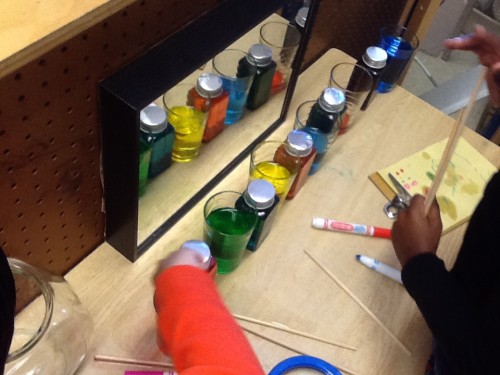
Now this is where it got interesting. A few years ago I might have considered what happened next to be a failure: a failure to explain the task or game, a failure to follow instructions. Now, I see it rather differently. I was surprised, and also a bit disappointed, when the sound of tinkling water glasses (so lovely!) was soon replaced by the sounds of water sloshing into glasses, and children saying; “ooh” and “ahh” at the spectacle of new colours appearing in front of them. Hmmm. Where was this going?

Our “potions” (the clear jars mixed up a few weeks back in a colour-mixing experiment) were quickly brought over to join the glasses, and the order rearranged to play with new ideas. Note the clipboard where Daniel had begun to demonstrate ideas to record a tune. Photo by Daniel.

See here how pouring is becoming the focus of the activity, with colour mixing and quantity both holding interest for the various students who come and go. Markers are used to compare to the “potions” and to inspire new mixes. Photo by Daniel.

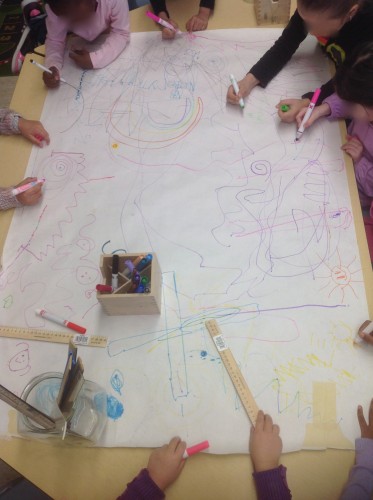
Now much of this rich talk is being captured by Daniel. Another ongoing inquiry has developed into a line exploration collaborative poster and I am there, capturing the talk and taking pictures. I was engrossed for a while and completely missed the spark that turned a musical invitation into a colour exploration. This is what is wonderful in a classroom of engaged learners: once students follow their interests and have developed the social and emotional (self-regulation) skills to direct their learning, I am able to flit from area to area or sit down and join in the fun. September isn’t like this, but spring is wonderful!

 Even our line collaboration becomes a celebration of colour. I stay a while before visiting the other area that’s abuzz with excitement.
Here a girl takes a picture of the array she has made with a friend. I love how she captures both the subjects and their reflections. Photo by A.

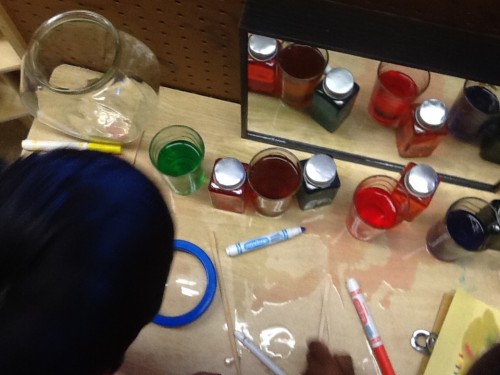
Now the pouring began in earnest: “Ooh, look what happens when we add these two colours together!”, “It’s dark like this one (potion jar)”, “What is this, brown?” See also how the chopsticks (intended as drumsticks or mallets to play music) have all become stirrers, and the clipboards for drawing out ideas have been forgotten.

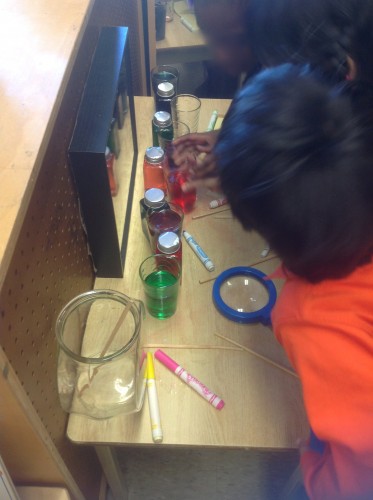
Magnifiers are brought to look closely at the mixtures in the jars and glasses. It is now beginning to get rather messy here, and materials are getting wet. Some students are concerned about the spills, while others are too focused on their inquiry to take time to notice the water. When I come over to investigate, I am torn between continuing the mixing and cleaning up the water that has now spilled onto the floor and is getting quite close to the building area carpet. After talking to the students at the table, we agree that this table isn’t quite perfect for pouring experiments because our spills are not contained. We clean up for home and plan to improve our area tomorrow for more exploring. Photo by Daniel.

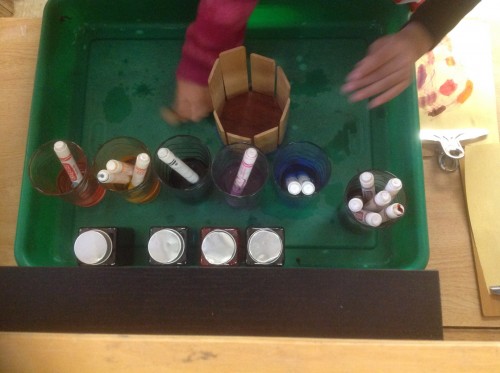
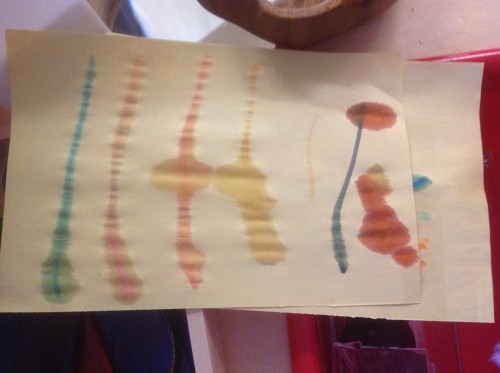
The next morning is mostly spent outdoors, and reflecting on how much time was needed the day before to really explore this invitation, we reserved the water music for another day. When the PM class returned, we gave the water music idea another try. After consulting with the students who had experienced the messy spills, we came up with the improvement you see below: use a tray! We kept the mirror behind the glasses, and I added the stirring drum, again wondering if this might suggest musical exploration. You may notice from the image below that there is music happening (one girl is striking the glasses with the mallet) but also something new… today we started with clear water, but the colour idea was too strong so students came up with this (brilliant!) solution: add markers and stir. I didn’t want to say: “no” but was stuck by the thought that markers might never be safe in our class again. Our compromise: we tested all of our markers! The new ones with bright colour were recapped and left for art. The dried-out markers were all brought here to test. This included sorting, comparing, negotiating (“This one’s red, we don’t have any other red”, “How about brown?”).

New potions are created, with surprising results as the colours darken over time.

 Here S happily transitioned from making music to testing the new colours achieved by adding the dry markers to the water. We all agreed that the new colours were beautiful and not just like the original marker they had come from. Interesting!

The delightful result of following a student inquiry. Saying “yes” really does help us get to know how creative and capable our students are.

 I loved the way the students surprised us with their ideas. I have to say I was also relieved that Daniel saw the resulting direction as interesting and worthy of following, not as a failure. Now, looking back on the learning, I wouldn’t have wanted to change a thing. However, I wonder what might happen now if I share my wondering about this with my students: if we tell them we loved their ideas but were also a little bit disappointed that we didn’t follow Daniel’s original plan, would this lead to a new attempt, and some discussion of what is a worthwhile idea to follow? I wonder…

 Now here I wish to share what happened the following week, but also to add some sights and sounds I was unable to add in the original post, as I wasn't able to embed the videos in the other format. From the first day when the provocation was introduced: how music gave way to colour exploration:
(note: click on the speaker icon for sound: I've set it to silent due to the distracting noise that occurs when embedded vines play non-stop. Click again to silence).


The next clip is from the second day, when the students requested both a tray to contain spills, and markers for rehabilitating.


I resisted following up on the interesting developments on Wednesday, instead enjoying beautiful outdoor exploring weather and focusing on a few of the other ongoing inquiries each day. In our planning for the following week, Daniel and I discussed revisiting the musical glasses through pictures and documentation. We decided that even though the morning class had taken interest in the artifacts and experiments left out overnight, it was the afternoon group who had taken ownership of the project and thus it was their class we would bring the discussion to.

We showed several images (simply scrolling through the original blog post and our class tweets) and talked about how we had planned for music but that we liked how the students were following their own plan so well. Then we brought up that this time we could come up with an idea together, using the materials we already had to whatever use most wanted. This was an interesting process! Here are as many of the ideas as I was able to capture during our meeting time at the carpet.

(Looking at the projected picture of the water glasses set up to play music)
C: We had to pour the water to make the sounds.
A: I know, let's do it again.
Ms. Fynes: What will it sound like?
Z: The big red one will be deeper. (The red glass is fullest, and least full is reddish too).
D: No the little one will be deeper.
(Looking at the picture where the potions have been added and puddles appear)
J: We spilled it on the floor.
A: It was spilling.
J: It was mixing: blue and green and red and yellow.
(Looking at the picture of the glasses on the tray with markers inside)
J: Oh! There's a lot of colours.
S: You put the tray there so if it spilled it didn't go all over.
(Looking at the picture with the clipboard where S tested the wet markers)
S: We put them in water and tried it.
Z: It looked like paint! The lines are bigger.
S: The small marker makes small lines.
J: The big ones made a big line.
C: They made a splash.
R: First we put water in and then we add the markers.

Next, after looking at the photos and discussing, we asked the students what they would like to do today, if given the same materials: 6 glasses, water, colour, sticks, trays, and whatever other materials or tools they wished to explore.

S: We could use water, music, and colour.
Ms. Fynes: I'm not sure I understand what you mean!
S: First we could make music. Then we could pour water, then we could use colour.
(several students objects to this, wanting to use for one or the other right away).
Daniel: Should we split the cups?
J: Different cups, yes.
J: I want to do the markers.
C & S: We used the "dead" markers (referring to those markers that had dried out).
A: I want to use water beads.
Ms. Fynes: Water beads in the glasses? Where would you use them?
A: In the water table! That's where the water beads are, right?

To help move the conversation along, as we'd been at carpet longer than usual and because I wanted to help every voice be heard, I drew all six cups on the white board. At this point I put my clipboard down so I don't have a record of what was said, however it took a few moments of growing frustration among students before "N" came up and started circling the cups I'd drawn, dividing them up to give two cups each to three different groups Daniel had recorded: music, markers, water beads. We were set!

N helped us divide the glass cups evenly between three centres. Students congregated where they wished to play: water beads in the water table, testing markers on a tray at the writing table, making music and pouring water on another tray.


What I learned on this day was that it wasn't necessarily important that the eventual play didn't last as long as we had envisioned (in fact two groups left for snack and moved on to a balance inquiry project elsewhere in the room), but that revisiting the pictures and talking about what went right and "wrong" the first time (students identified the spills as something to avoid, something wrong) was valuable even for those students who hadn't participated in the explorations on one or both of the days the week before. Students were able to assess the photos, ask pertinent questions, and identify possible problems, simply by looking at what their classmates had done.

Another valuable take-away for me was simply the power of students self-documenting their inquiries. I have joined Suzanne Axelsson's "Through the eyes of the child" project this spring and I'll soon be reflecting with the students which of their photos capture the story they want to tell to an international audience. Though we haven't yet chosen our photos, using this lens has made me aware of the importance of looking at the photos we share, on twitter and in the room.