Sunday, 22 February 2015

ordinary magic: ice inquiry, part 2

Last week I began to tell the story of why ice has meant so much to the learning journey in our class this year and over several years. Before I sat down to write that post, I'd spent much of the weekend exploring the magnificent ice formations growing along the shore near my home, because the temperature at the time was in the -20 range with windchill values nearing -40. The deep freeze continued this week in school, thus we had several days indoors when the extreme cold meant outdoor recess was cancelled. By Friday, I couldn't wait to get outside and see the shore again. This weekend we've had snow, so much that the landscape is mostly white with trees, rooftops and field covered in white. Nearby Etobicoke Creek still flows under thick ice but it's nearly impossible to see.


The beach disappears as the deep cold (-39 windchill) freezes waves into undulating shapes on the shore.
This crack was the only sight of the wide creek rushing below the ice and snow.


Back in the warmth at home, I thought about how our students got to where we are now, thinking deeply about how we learn. The year began with learning about our bodies, including our own "Best Part of Me" book. This is our first year of FDK at Thornwood PS, so there was new learning for all of us: the returning senior students who'd only had me for half-day Kindergarten last year, the new junior students for whom all school was new, for my wonderful teaching partner Pooneh who was new to Peel Board (and who I wrote about in a previous post), and for me, learning to share the learning with a teaching partner. We weren't sure what inquiries might develop early on, so we both spent time getting to know our students through shared play and through group invitations. Much of our first month was spent outside, using a skill the seniors remembered well: "looking closely" at our environment to learn about what lives in our schoolyard. As our class began to settle into the new routines, Pooneh and I often split our large group into two, each taking half of the students to do a smaller circle exploration of materials or a read-aloud. Her ECE expertise was quickly evident to me as she created many sensory invitations to hone in on understanding particular parts of our bodies and our traditional "five senses".

This book inspired us to create our own book of our"best part" pictures and stories.


From there we rather naturally moved into health, both body and mind. Perhaps because so many of our inquiries flowed out of ongoing explorations, much overlap has occurred from project to project. Current inquiries such as body balance certainly link back to that first month's look at our bodies and what we love to do. The ongoing ice projects are certainly about the mysterious properties of frozen water and other materials through the lens of scientific exploration, but a secondary aspect of the long interest in one project is the way some students are developing metacognition about learning, perspective, and ideas. Ice continues to motivate deep thinking and joyful engagement in our class. In part 1, I shared my own fascination with water in winter, and then how #iceinquiry began to unfold this year in class in late fall. I left off with a collaborative inquiry between our class @109ThornKs and my friend Kelly Wright's class @KinderWonders which inspired our students to incorporate colour into their designs. Kelly had continued to explore this with her class during that last week of school in December. What delighted me was to see how our collaboration was inspiring some pretty incredible thinking among her students as well.


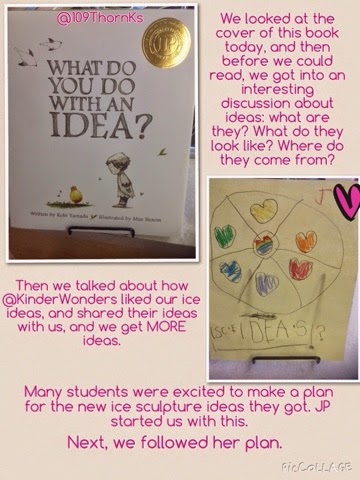
This spark happened right before the winter holiday break. I wondered as the holiday began if the interest in ice projects would fade away, with gifts of new toys and movies seen with family sure to bring new ideas to our conversations. Not ready to move on from the exciting observations about ideas and learning that came up when our students commented on @KinderWonders creations, I brought a new book to share when we returned in January. The funny thing was, we didn't even open the book and read it, because the conversation that flowed once we looked at the cover was too rich! We saved reading to allow the students to share all the ideas bursting forth.

The story was captured in tweets by both myself and my partner Pooneh, as we share the @109ThornKs twitter stream. See the exciting week that unfolded when we asked: "What are ideas and how do we get them, anyway?" Note: some collages included in the slideshow are repeated in this post, as reading the small print can be difficult in the embedded storify below.


Lime ice - a sensory delight that scented the room.

Drawing plans and preparing sculptures for the freezer.

Now seemed a natural time to explore ideas, thinking, and inspiration. The collages below (also included in the storify slideshow above but repeated here for larger viewing to read the print) represent an attempt to capture all the new directions our body and mind, and our ice inquiries were going to expand. When I look back at this documentation, I see what I was missing back in 2010 when I directed the students to all do a drawn and written response to our ice experiment. These days, I try to always let students know that next steps come from them, while ensuring time to reflect on what has happened and to ask questions generating new ideas. This has allowed me to see the students as capable learners whose curiosity and insight is the most important resource in planning experiences.


What emerged from the conversation about "ideas" was incredible: thanks to the spark shared by JP at our welcome circle, the new way for students to create sculptures included drawing (and writing) detailed plans including the materials and tools needed for the project. When so many plans were drawn and created we ran out of space in the freezer, a space on the board was created, dedicated to "tomorrow's projects". It wasn't yet cold enough outside to use the yard for our ice projects. That would come soon enough. We also spun off into studying "brain food" due to the comment "fish is good for our brains", which lead a small group of students to join Pooneh in the library to conduct research into brains and ideas. On another level, we were learning how to conduct research, looking closely at information texts to glean what we could from words and pictures. This skill is one that our students will carry with them for life, and it emerged (as it often does) from deep interest in a topic that arises during a class conversation.


The emergence of several new inquiries in our class in January (including a fire truck project sparked by the local Fire Fighters' visit to our school and an interesting look at gender and identity through toys) meant that the ice projects went hiatus for a few weeks. The learning thus far would have been enough for me to conclude that it was one of our biggest inquiries of the year. When it reawakened, however, the excitement surprised even me. Our collaboration grew to include several classes and teachers whose communication with us helped our ideas grow. Indeed, the word "inspire" became a concept that spread to all we do in room 109. But that is a story for another post.


Monday, 16 February 2015

ordinary magic: ice inquiry, part 1

This morning I walked along the shore near my home, looking to spend some time on the beach conducting my own survey as part of the annual "Great Backyard Bird Count". I also wanted to see the beach in the brilliant sunshine. I knew the deep freeze this week would bring more fantastical ice sculptures where the lake's waves, whipped up by yesterday's terrific winds, would crash into the shore and splash up to the trees and rocks all along the edge. Sure enough, today was spectacularly beautiful. I've been thinking about writing a post about ice for some months now, but just as I think it's slowing down enough for me to sum up the wonderful winter explorations thus far, new sparks emerge and students take the #iceinquiry in a new direction. In fact, it's been about a year that I've been mulling over writing about ice as a material worthy of deep study. This has kept the post in draft form, as I tried to figure out when it was exactly that I fell in love with the ephemeral, unpredictable substance. My first thought was to look at my older photos, from the first years we moved out to Long Branch from our old downtown Toronto neighbourhood. Winter on the beach, bringing with it great rafts of winter ducks not seen until the snow flies, also brings unique scenes of beauty like the two below. Once I discovered that a windy day would dress the willows, or how gentle waves would form into an incredible variety of shapes at the water's edge, I couldn't wait for the temperature to drop each year. Imagine the sound of those icy willow branches, tinkling together in a light wind. Picture the water lapping up over the clear baubles, making the organic shapes disappear and reappear every few moments. It is a place of wonder.


I noticed today that my first blog post was graced with an image from the beach, icicles reflecting off of the water that kept rising up to meet them. The end of 2013's dramatic ice storm likewise brought me out with my camera, carefully slipping along the sheer sidewalks and ever wary of the heavily-laden tree branches overhead, creaking and bending under the weight of several days' worth of freezing rain. It was frightening to travel in the neighbourhood right after the storm, but I couldn't resist the beauty of the world looking bejewelled.

Back in the spring of 2010 I was teaching in an AM & PM Kindergarten in Brampton. At R.J. Lee we had a meandering creek in a tree-lined ravine, right next to our school grounds. I often took my classes for walks through the ravine path, and more often that not we gathered interesting natural materials along the way. Sometimes these leaves, pine cones, stones or other objects would become items in small world play or added to random loose parts in our nature area. I'm not sure what gave me the idea, but I suggested to the AM class that we create a sculpture out of our findings. We popped them all in a pie plate, wound ribbon through the middle, and put them in the freezer. The afternoon class, upon hearing about our project, asked if they could create one as well. I didn't know what we would do with them once frozen, but I was delighted by their initiative and so we also went for a gathering walk and made another sculpture.

Here are some scenes from my classroom that week in March. I realize now that although I wasn't using the term "look closely", this was one of the first co-created projects that really invited students to look closely, make observations and predictions (about what would happen, which item would melt out first) and plan further investigations. I admit I had a laugh looking back when I saw the response page I created for students so that they would draw, label and write an observation (I didn't ask them for an observation in fact, but instead left a space for only one possible response: "melted"). In the intervening years my approach to teaching and learning has changed. I suppose my own learning about students has changed me each year, and I can't think of any time I wasn't adjusting my lessons, my routines, or my idea of what was meaningful to early learners. In any case, looking at these photos, I see I still expected each student to complete a response on paper. I invited them to capture what they saw before it melted away. I loved how some students captured the action, showing drips in their drawing, while others focused on the colours or shapes within. My way of framing the task (draw what you see, label) is still very much a practice in our class now, though it is a choice to participate. In this project, I was still the one making the decisions about what we learned and how it should be shared. I regret what was lost by not getting those students to talk about their own ideas and write a sentence based on their observations, their aha's, or their ideas for new projects. Seeing that flourish in our class this year, I wonder what might have happened if I had then asked: "So, what would you like to try to create next time? What do you think might happen?"


I was taken with the interest and engagement of nearly every student. They were investigating the same materials which they had collected, but were now much more interesting simply because they were suspended in ice. So that weekend I made a sculpture at home with my daughter who'd just turned three. We used pampas grass, an insect gall, sumach and cedar, pine cones and needles. My girl was delighted and danced around the little garden, admiring the ice sculpture from many angles, even swinging it so it would "twang" against the metal rails. She caught drips on her hands, on leaves, and in her mouth. She asked for a stick so she could reach it from the walkway, and tried putting fallen items back into the sculpture when they dropped. She was showing me the way to true emergent curriculum, exploring with all her senses and not waiting to be told how or why or what. I saw how much more there was to see in a simple circle of ice.


Recently, while visiting my parents up at my family home, I mentioned some of the ongoing ice projects in our class. My mom reminded me that my fascination with ice began long before I moved to Long Branch, long before I had my own children to dazzle with our beach's magical transformation in winter or little projects. At home where I grew up, we had a small but deep pond. Summers were spend swimming or dangling our feet off of a floating dock, inviting the many goldfish within to "nibble" at our toes. Winters we spent shoveling the pond clean of snow so we could skate. One year when I was young, my mom found a goldfish frozen in the ice. She cut a chunk out of the surface (my sister remembers her using an ax for the job) and brought the block of ice inside. We placed it in a large tank with cold water and waited. The fish thawed, began to swim, and became a family pet. That fish, "Saratoga" (so named by my sister who wanted to name it for the colour of the crayon "Sarasota Orange") became a family story much-shared with visitors who admired the tank or the pond. I also remember waiting for the pond to thaw each spring, and watching as the fish began to stir under the ice, showing through the thin sheet like glowing orange lights under glass.

So with this fascination of mine for the ephemeral beauty and mystery of ice, I have used it as an invitation for learning often in the last few years. This year it started early in the fall during our explorations of various senses while learning about our bodies. Pooneh made several trays full of ice cubes so that each student could have their own cubes to feel and explore. There was much squealing around our long banquet table as the ice melted, slipped off of plates, chilled fingers and cooled tongues.


In November we had quite a lot of gathered materials from our outdoor explorations around the yard and around the school neighbourhood. I wondered aloud if anyone would like to use some of the 'tree gifts" to make an ice sculpture. GS and JE, both senior students who remembered the ice projects we'd done last year, jumped at the chance. I gave them the recycled vegetable tray and twine. GS asked for a bottle for water, and JE went about adding pine cones, bark and acorns. Another student added a dried apple we'd found under a nearby tree, and an oak leaf. GS estimated how much water she would need and cut the twine to her liking, and we popped it in the freezer. Thus began first hanging project of the year.

Remembrance Day. GS creates her own ice project while ES looks on.

The next day, we retrieved the ice sculpture and hung it near the window where we could watch it drip and spin in the light. GS helped to remove the sections from the tray, but then became interested in another project elsewhere and left me to suspend it over a tub. Students who hadn't noticed her create it yesterday were drawn to the sight of the ice chunks, all dangling in a line. Clipboards and markers were brought over from the nearby "look closely" centre, and students began to draw what they saw. I was delighted by this spontaneous response. As the first few items fell, a game of prediction was born: "The pine cone is next", "No, this leaf is going to come out".  One boy, RR, spend a long while collecting drips on his hands and on a magnifier, counting each one and guessing which ice chunk would release the next drip. The sculpture melted bit by bit over the morning, but we gathered it back into the tray, topped off with a little water, and returned it to the freezer before we headed outside to play.


Many students visited the dripping sculpture over the morning.
 "The apple is cold". "This one is loose! It's going to fall next".

Most interesting to me was the way that two girls, ZS and JP, drew their observations. Looking at the same thing, they drew entirely different diagrams, each very detailed. I asked them if I could share their drawings with the class at the next day's welcome circle, so that I could highlight the way they both captured important details so distinctly. The conversation sparked many more students to examine the sculpture, hung in the window once again but dripping faster this time as the sun shone in the windows. Many more students added observational drawings to the collection which we wound up hanging on the wall to share with visitors.


Below are the collages we shared with our families and followers on the class twitter. The drawings sparked an interesting conversation the next morning, about how we can look at the same things in the world but notice different aspects. It was our first real large discussion about perspective and ideas, a topic that continues to arise in the months since this day. It also sparked many more drawings by other students inspired to take a look at the ice and use their own perspective.


To see the story as it was tweeted out that week, simply follow the thread from the first day. In the thread are images and vine videos of the process of creation, exploration, and reflection.

Now at the same time that the hanging sculpture was generating interest in indoor ice projects, it was beginning to chill outside as well. That week we saw some snow flurries and found puddles which froze overnight. Many little projects sprung up, including a repeat project from last year, our "weather bottle" inquiry which was remembered by several students who were then juniors in our class. Those sparks led to interesting projects, but I'll save those for another post. The next chapter in the hanging ice inquiry story began when we got a tweet from our friends in nearby Clarkson PS, @KinderWonders. They had admired our story and used it as inspiration for their own ice project. I was delighted. Last year this same class had sparked a long-lasting collaborative inquiry between our two classes when they commented on a building project going on in our room. The critical thinking that became evident as students pored over the pictures coming in from the other class was astonishing, and worthy of a post of its own. So, wondering what might come of it, I showed my teaching partner Pooneh and we agreed to show the tweet (seen in the top corner of the collage, below) to the class. The collage shared what we managed to capture of a larger discussion. Our students were inspired and excited to try something new.


It is hard to capture the excitement that has developed out of this initial month of ice inquiry. Students have become aware of their own perspective when making observational drawings. They have begun to create elaborate plans, both in drawing and written form (prompted by Pooneh and I when we were overwhelmed by the requests for more and more materials and more space in the freezer). They make connections to earlier attempts and make increasingly more accurate predictions about the results of their personal or shared experiments. This is only the beginning of our ice inquiries this year. More will follow in part 2.


Saturday, 15 November 2014

On becoming two


I have been thinking for a while about a way to introduce my wonderful teaching partner, ECE Pooneh Haghjoo. This year has been fast-paced and action-packed, much more than any year since perhaps my first year of teaching (hence a long time since my last post). Although in some ways this year has been the most difficult in memory, with issues and events popping up to complicate the usually busy but joyous job of teaching, I've had many moments of looking over at my partner and thinking: "How did I get so lucky?" Transitioning to FDK has come with many challenges, and not the parts that I anticipated being difficult: the project-based learning from following children's inquiries that our school board and our Ontario curriculum document support is a big part of our K team's culture. Learning to work around sharing the yard throughout the day with 3 other classes and more planning times to consider, more kids/less materials/equipment/space with large classes, among other items on the learning curve. Not difficult this year: finding a way to share the space I'd made my home over the last two years. I'd been told it can be something like a marriage, in that two people share intimate quarters, materials, kids and important responsibilities. I imagined I would be hard to work with: I'm always making plans based on kids' interests and questions, then throwing those plans (and assembled materials/provocations) away or aside when a more powerful learning experience comes up. I've so many loose threads on the go, like my browser which always has at least 5 tabs open... I'm not the calm, quiet one in the room. I'm excited about life and learning. I'm passionate about the environment as third teacher and learner collaboration as the key to inquiry. I'm also loud, often provoking students with musical or noisy invitations to play. I'm happier outside than in, especially because I believe I see the true personality of children when all of their senses are fully engaged in learning, which is much more possible outdoors in every season.

Over the summer I engaged in losing myself in the big, beautiful outdoors with my family. The growth in my kids, especially over our 2 weeks visiting family and friends in BC (shared in this earlier post), was incredible to me. So it was with some trepidation that I returned to school where we were entering our first year of FDK and me not knowing my partner's name or anything about him or her.

In some ways, it was not unlike moving schools like I did three years ago when I left RJ Lee PS in the north after eight years in the same spacious Kindergarten classroom. My commute was a long one but it was hard to leave a community, both my colleagues and the families of students, some of whom had two and three siblings join my class over my time there. I fell in love with the people, but also fell in love with the tree-lined creek that snaked past the school on our north boundary. Walks along the path were "trips to the jungle" and "forest adventures" to my students. We saw cotton-tail rabbits, geese and mallards aplenty, and even a pair of wood ducks one summer day. We went often to "visit our ducklings" every spring. And watched them grow from fuzzy yellow balls that "peep!" through the awkward fuzz and feather stage, always running after "mama duck". We peeked at the school through breaks in the leaf cover, and felt like no one could see us. Leaving RJ Lee was difficult for all the reasons mentioned above, but for me, having grown up in the countryside with a swimming pond and forests to wander in, leaving the little piece of wild behind was really hard. I couldn't imagine finding anything like it anywhere again.

It's not that different for our students, coming to our classes as their first experience of school. What will it be like? Will I make friends? Will it be safe? Will I have fun? Will I know what to do? Moving to Thornwood PS, I was delighted to discovery it was bordered by Cooksville Creek, and that it has the unique "no-mow zone" wild learning area just across the field from our classroom windows (described in this post). Likewise, while I was eagerly anticipating finally joining FDK, I was full of doubts and questions. Last year I had asked Tessa Heffernan, (a PLN friend whose outlook on the learner as capable always shines through in her writing) if she would share what makes her partership with Holly Diljee such a rich and rewarding relationship for the both of them. I was so touched by the obvious love and respect in the post, and it both inspired and worried me. How likely was it for me to be placed with someone who I could see eye-to-eye with on daily matters and big ideas? Tessa's words below, taken from her guest post (see here) really summed up what I had found with the OCT team at Thornwood over the last year, and what I really hoped would be possible with our new ECE partners.
A Joint Philosophy
I’m going to be honest and say that we simply lucked out when it came to similar philosophies.  We both are huge proponents of open-ended materials and activities, uncovering the curriculum through play, emergent learning, a natural and warm environment, choice, supporting and promoting self-regulation, building relationships and teaching skills as opposed to discipline, and making developmentally appropriate decisions.  These goals allow us to constantly focus on the ‘why’ behind our decisions.  If a school-wide activity comes up, we make a decision about participation based on our philosophy.  If we are considering a provocation or activity, we think about how it fits or does not fit with our programming.  If children are taking part in an “outside of the box” exploration, we generally ask ourselves two questions:  1. Are the children being safe?  2.  Are the materials being respected?

It's hard to believe now, only a few months in to our time sharing a classroom, but I feel like Tessa's words ring true for me in so many ways. Pooneh has a wealth of experience as a teacher first (back in Iran) but also ECE experience in Canada with early years teaching, mostly with toddlers. Her obvious love of the students is clear to all: our parents, students, and all staff at Thornwood. Her way of reading students' body language and participation to know when it's time to change our routine, our set-up or even simply the story being read aloud? She is a consummate teacher, always listening carefully to the students, looking closely for themes emerging that she can extend. She is patient with young students who say: "I can't" even when they very likely can. She is as fascinated with the way kids think (including their interesting wrong conclusions to experiences) as I am, which belies a powerful belief in kids as capable learners with gifts and ideas of their own. She is patient with allowing students to struggle when it will lead to greater understanding, but also willing to help when a tired child is past their ability to persevere. In short, Pooneh embodies the model of scaffolding learning in her approach to teaching. I wound up with a partner as solidly convinced about the rightness of emergent curriculum as I am.

Her sense of humour lifts me when I'm frustrated with some mundane issue after a busy day. Her joyful embrace of experiential learning, the aspect of a partner I was most worried about? It shines through in her words, actions, and daily documentation of our students learning together. At first I wasn't sure how to add a second user to our class twitter page, so I would simply retweet her posts onto our class page (as some of those I've included here). Now that we share the account as authors, I find myself looking at our page and grinning when I see a new post of a moment I witnessed from across the room (while I was engaged with other students) or often not present for (while one of us takes a group for walks as the other teacher remains in the kindergarten yard with students using outdoor equipment). I appreciate how she sees the growth of individual children as well as the bigger ideas unfolding in their play within groups. It makes me think of how rich our reports and interviews will be, looking at the wealth of observation and documentation she brings. I love the way she captures the joy on the students' faces: though we obscure faces to protect student privacy, the grins are evident in photos of experiences inside and out of the classroom. I also grin when I see a post "faved" by our own account, knowing Pooneh has just come across something I shared that she finds delightful.

Below are just a sampling of tweets that show the joyful learning that my partner has captured this year.
September 17th was "International Flip a Rock Day" and I knew whatever else came our way, I had a partner who saw the value of free exploration outdoors. 

"Look Closely" truly became the culture of my classroom last year when I was still 1/2 day (and thus no teaching partner at the time). It was obvious pretty quickly that Pooneh sees the magic in the littlest moments, too.

The above tweet shows one of Pooneh's many projects undertaken to answer a question or spark from one of the children. It may have grown out of this noticing by several children much earlier on. (tweet below).

One of Pooneh's many invitations for students to explore materials using their senses.

 No explanation (of above tweet) necessary.


Pooneh and the kids playing under the oaks.
 Moments of exploration that resonate for me with the
inquiry-learning approach as outlined in "Worms,
Shadows and Whirlpools".

Earlier week, Pooneh brought a child-sized table and chairs for the classroom, and yesterday she invited students to help her wash it and restore the loose trim with glue. A group of students jumped at the chance to help. I missed almost all of it as they were working away in the cubby area while I was working with others in the classroom, in particular capturing moments at the ice inquiry table we'd set up near the windows. Later that day I smiled when I saw this:

I captured these four girls playing with Pooneh in the cubby while waiting to be picked up at the end of the day: "We are drumming on the table that we worked so hard to clean" say JP and EW (click for vine clip).

Another delightful moment in the day occured during our long "Play & Learn" block in the morning. Students playing with the medical tools from the class "Veterinary Kit" decided to take care of Pooneh instead of animals or other student patients. I wonder now if it was because of the morning conversation at welcome circle when she shared she wasn't fond of the cold weather. She waved at me, holding her "prescription" from one girl: a trip to the beach was the doctor's order. More prescriptions followed.
I know that our story has just begun, and that much learning will occur before the year is over. I have much to learn from my partner and it is still early enough in the year that we continue to tweak our schedule and environment in order to meet our students' learning needs... but I am confident that from now on, classroom stories will be "our stories". I am extremely grateful for my partner. From there, much is possible.

Addendum: when I see the way all the Kindergarten classes have grown over the last few quick months, I'm truly pleased that our new ECE partners are equally on board with the adventure of child-lead, play-based learning as our OCT team are. I often fave tweets from both ECEs and class accounts (some are sharing account like Pooneh and I now do, other classes retweeting from ECE as we did) and I'm delighted at the rich conversations taking place between classes and over lunch in the staff room. Though our school experienced a painful loss this fall that touched us all (deeply felt in Kindergarten), our team is so full of passionate teacher/learners that I expect we'll continue to meet all challenges as a family. I feel incredibly fortunate to work with my Thornwood PS colleagues.

Nothing without Joy - Loris Malaguzzi


Sunday, 24 August 2014

the story of Pelly

Loose parts play involving math, art, storytelling... N's father fish helping to feed his babies in a symmetrical pool.

The first half of this post was first published in June on the Peel21st Project 184 blog, under the larger blog project lens of "What I Learned Today" (see original here). Upon reflection later after our final week of school, I found that I had learned a lot about my students even as the school year was coming to a close and I was no longer working so diligently to notice and document all the learning. I also noticed that, even when I knew I had to start breaking down the classroom and getting ready to let go of my students, I found it very difficult to turn off the part of me that is always looking closely, listening, documenting, prodding new questions and explorations.

After a brief introduction on the blog, I told the story as follows:

Yesterday after morning dismissal, I discovered a package in my mailbox. It was addressed to our class, from our friends in Mrs. Lowe’s Kindergarten in Winnipeg, Manitoba. I didn’t reveal the package to my afternoon class right away, as it was our outdoor “Play Day” and thus I didn’t expect to have a rapt audience; after all, my students had just seen the banquet of delights that awaited them upon arrival. The Kindergarten team had set up an impromptu water wall, a sand castle centre, weaving, picnic area, frisbees, bubbles, bikes and scooters out beyond our yard, chalk, paint, ball games, and more. These outdoor play days are the sort of event that older students remember fondly and ask about when they see you in the hall: “Hey, Ms. Fynes, are you guys having play day again this year? Do you need any helpers?” I dropped my mail on my desk, reapplied sunscreen, and headed outside for more fun.
While the package would be a surprise for my students, I had already learned about it a few days earlier. A little while ago I had sent a parcel to Connie Lowe, a Kindergarten teacher in Manitoba who I follow (both PLN and class) on twitter. She had admired a photo from our class, and commented on the beautiful beach glass the students were using in their creations. I showed this tweet to a few students and asked if we should send them some of our glass, as we have plenty to share. They liked the idea. Two girls also agreed to create some pictures to illustrate a favourite way to use the sand-softened glass pieces: making mandalas. I mailed the parcel with their illustrations and sent a “hint” to the class of what was on its way west.
Soon after we got a “Thank you!” tweet from Mrs. Lowe.
I showed the girls who’d helped assemble the gift, and that was the end, I thought.
Then Connie tweeted us a hint, in the form of a blog post, that we would be receiving a gift in return. Her post was so surprising it brought tears to my eyes. I wondered how my students would react to this generosity from a class so far away.
Today we sat down to our welcome circle, and opened our package. I was sad to note that the two girls who had sent notes and pictures were both absent today. This didn’t dampen the excitement in either class when I showed the tweet we had sent, to set the stage for why we had received this gift in the mail.
“Pelly” was received with a chorus of “ooh!” and “wow!” and quickly passed around the circle as we read the notes Mrs. Lowe’s class had sent us.
It impressed my students so much that students we didn’t know would share something so precious with us.  These words came up again and again: “They must miss Pelly”, “They are so nice”, “I love Pelly”. In the afternoon class I had time to share Connie’s story when I paraphrased her blog post and showed the movie her students made. My Ks were so full of wonder, and empathy (“She looks like she’s crying” was said about one photo in the movie) and ideas: “Maybe we could take a plane to get there. It’s far”. Students made Pelly a nest, improvised eggs with stones, made thank you cards, and asked me to tweet @MrsLowesClass several times to say thank you and to ask questions.
My name is Laurel, and I love the wonder of children and the power of social media to connect us to learners near and far. What I learned today was that my very young learners are quite capable of understanding how others feel, even when those others are people in another province. I learned that generosity abounds in my students. My students learned, yet again, that we have friends like us all around the world. (end of original post).

From the moment Pelly arrived, almost all of my students (both morning and afternoon classes) became engaged in new inquiries, all spurred on by the arrival of our new provocation. Pelly inspired students to inquire into pelicans, naturally, but also into feathers, flight, nests, fishing birds, swimming and diving, geography, social etiquette (the desire to send thank you notes and reciprocal gifts was overwhelming), the loneliness of moving to a new place, and more. I can't help but wonder what learning may have come if it weren't the last days of school! Here follow many of the tweets that came out of our room once Pelly arrived. The thought that went into the actions seen in photos and vine clips below (e.g., exploring flight with feathers and paper airplanes, creating nests and finding loose parts food for Pelly, writing letters and making pictures for our faraway friends in Ms. Lowe's class) proved to me again the power of following a spark or provocation through all the myriad ways students wish to interpret their wonders.


While the student engagement was powerful, I have to admit the teacher engagement for me was a highlight of a wonderful year, full of such rich moments. (Another collaborative inquiry shared with Kelly Wright's class, a near-neighbour just west of us in Mississauga, will feature in an upcoming post). The connection made by sharing the wonder and delight of our classes captured the imagination of our principals, both supporters of inquiry-based, student-driven learning. The way our young students took initiative, showed their compassion and their generosity, and continued to be actively engaged in their education right into their last days of school impressed upon all of us the importance of giving our students the materials and letting them dictate how to interpret them. We were far apart but met in wonder, because all roads lead to Hawkins.


As I look back on what was an astounding year in terms of all the explorations that took place, I also look forward to seeing more exciting projects unfold with our twitter friends, now following our new class name @109ThornKs as our school transitions to FDK. The name change represents an exciting change for our class: we are now two educators and one, all-day class. Pooneh Haghjoo and I will be learning together how the days will flow, and how our learning community will grow. I'm excited to learn and teach alongside my experienced and passionate new partner Pooneh.


Saturday, 16 August 2014

musings on what really matters, from a valued friend

I don't wish to take much space here because the beauty of Tessa's post is perfect in its entirety. I do, however, want to share how it came to be I was able to bring this unique voice here. There are many people with whom I've made a connection online (through #ReggioPLC twitter chats or spontaneous conversations) that goes beyond "twitter follower/PLN". There is something about the way we share a view of children (as infinitely capable, curious, fascinating) and teaching (as a wondrous journey, forever deepening and growing out into our lives) that creates real friends through the ether. So naturally, when there is a chance to meet these inspirations in "real life", I jump at it. Tessa and Holly came to Toronto for an Ontario Reggio Association conference in the spring, and though I was unable to attend I was not going to let the chance to break bread go by. We wound up having quite the emergent curriculum model walking tour of downtown Toronto (that was my fault, imagine a toddler taking you for a tour: smells, sights, sounds all stop me in my tracks constantly). When we finally sat down for a cuppa, I felt like these two wonderful educators were long-lost friends. It was an interesting coincidence that Tessa sent me her draft during the week of the second annual "Reggio-inspired Summer Intensive" course where many of us thought about the #ReggioPLC voices we were missing, such as Tessa, Tracy, Nancy, and many others. Teaching through the lens of joy, discovery, curiosity and possibility does make life and friendship seem so rich. 
What follows is Tessa's story, with all photos by Tessa or Holly.


A Teaching Partner Forever Changes You

I was thrilled when Laurel asked me to write a post for her blog...ten months ago!  In true Laurel fashion, she gave me complete free reign over what to write and I mulled over a variety of topics as I worked my way through my first year in Full Day Kindergarten.  After the year was finished, I thought it would be the perfect chance to share some of our learning.  But as I wrote what I thought was going to be an overview, one element continued to stand out:  the educator team in FDK.  Within everything I wrote emerged the experience of working, collaborating, and dreaming with a teaching partner and so here I share with you our journey.

Words could never fully capture the impact of teaching alongside a partner and, more specifically, with Holly Diljee.  Let’s be honest here - there is a period of time before beginning the journey with a teaching partner of extreme trepidation.  Will my partner be okay with my spontaneous nature and habit of making regular changes to plans throughout the day?  Will I feel like a fool doing my typical singing/dancing routines in front of another adult?  Will our philosophies be similar?  What if we disagree about things?  How will we know who does what throughout the day?  But all of this trepidation is now a distant memory.

Holly reading a story outdoors.

Planning & Creating Our Environment Together

I knew things would be amazing in the first email I received from Holly.  I was fairly certain we would be a great match.  And then we began working together and I felt beyond fortunate that our paths had met up.  I think the first time I realized what an impact Holly was going to have on my teaching was when we sat down together to plan out our room.  She had such innovative ideas and considered elements that I had not thought of before.  She suggested that we put our dramatic play centre in the middle of the room to act as a divider and, through conversation, we realized it also sent a very strong message about what we valued in our classroom.  I wanted our couch to be within eyeshot when entering the room to send a welcoming message and she suggested that it be placed within steps of the doorway.  Our conversations began to open up a whole world of “why nots” and “I wonder ifs” and “wouldn’t it be great if we”.  In fact, just the other day I texted Holly to tell her I was getting my hands on a beautiful tea service set thinking strictly about using it with water.  She immediately responded with excitement about a provocation with various bags of tea and, like that, the idea grew.


photo 4.JPG


After initially setting up our environment or adding, changing and adapting our space, we always step back and watch.  Are there challenges within our design once the children are in the space?  If we see something that isn’t working, we first adapt the environment before thinking about the “behaviour” piece.  For example, when we first set up our couch, there was a ledge along the back.  Children were standing on the ledge and somersaulting over top.  While this is excellent gross motor exploration (!), it became a huge safety issue which is our priority.  We hypothesized that if we were to set something along the ledge that was beautiful and required care and gentleness, that the couch would become a place for quiet and calm again.  We set boards along the back of the couch and placed potted plants on the boards.  Without repeatedly discussing flipping over the couch, a small change in the environment redirected the children.  Of course, there are many times where discussion (reciprocal discussion) is needed but we try, where possible, to begin by making changes within the environment.


photo 5(1).JPG


photo 1.JPG


Rich Reflection as a Team
I think the element that stands out most about our relationship is the deep level of reflection that comes throughout the day.  We talk about student interests, extensions to provocations, fairness of expectations, changes to scheduling, adaptations to environment, level of engagement, rich questioning, effective documentation, children’s individual needs, curriculum connections, small group focuses, developmentally appropriateness,  embedded assessment - the list could go on and on.  We are often asked when we find the time to talk.  Early in the year, we had a huge piece of chart paper where we could each write down emerging interests we noticed and ideas for materials or next steps.  It is certainly true - there is never enough time in the day to fit in all of the richness of conversation.  Unless engaged in exploration/documentation/conversation with a child or group of children, we talk throughout the whole day.  Sometimes it is a quick flash of a photo on the iPad from across the room.  Often it is a pointing at a group of children engaged in an activity or a quick “Did you see what so-and-so was up to over there?” with a knowing smile.  Regularly we reflect on next steps/materials for a provocation or centre.  Many times it’s a quick stop to list off things such as “patterning, measurement, sorting, positional language” as one of us documents children building at the block centre.  And when we run out of time during the day, we Tweet photos or thoughts back and forth when there is time at night.  


A Joint Philosophy
I’m going to be honest and say that we simply lucked out when it came to similar philosophies.  We both are huge proponents of open-ended materials and activities, uncovering the curriculum through play, emergent learning, a natural and warm environment, choice, supporting and promoting self-regulation, building relationships and teaching skills as opposed to discipline, and making developmentally appropriate decisions.  These goals allow us to constantly focus on the ‘why’ behind our decisions.  If a school-wide activity comes up, we make a decision about participation based on our philosophy.  If we are considering a provocation or activity, we think about how it fits or does not fit with our programming.  If children are taking part in an “outside of the box” exploration, we generally ask ourselves two questions:  1. Are the children being safe?  2.  Are the materials being respected?  This can lead to water on the floor and sand in the dramatic play centre which can also lead to creativity, imaginative play, ownership of materials, and responsibility in tidying.  
It can also lead us to make adaptations in the classroom such as realizing more materials were needed at the dramatic play centre to bake with and making a batch of playdough/cloud dough.  We also took time to write up our philosophy to be shared with supply teachers.  We wanted to ensure that we were explicit about our thinking to allow for comfort for guest teachers and to ensure that children were able to explore and investigate in a similar way to when we were in the classroom to ease the change.  We have discussed writing up a formal philosophy to display to make our thinking visible in the classroom.  That’s not to say that we don’t discuss ideas from different perspectives.  There are times when we share an idea and say “What do you think?” and we have a conversation rooted in our philosophy that helps us to make a choice.  No decision is ever made solely by one of us.  We are a team.  

photo 2.JPG 

 photo 1.JPG

photo 4.JPG

Intentional and Thoughtful Programming

    As we make decisions about our programming and schedule, we always try to bring ourselves back to our philosophy.  If we believe x, they we are demonstrating it by y.  

If we believe self-regulation should be a huge focus, then we need to provide choice and opportunities for children to self-regulate.  We decided very early on that we would invite children to choose when they would have their snack.  We designated a snack table where children could freeflow from discovery centres to snack and back to discovery centres.  Early in the year we heard children saying “I’m hungry” and we assisted in co-regulating by making suggestions.  It was amazing how quickly the children moved to simply going to get their snack when they needed it.  Children in our room are able to eat throughout the day whenever they choose.  I think of myself and how it is impossible for me to concentrate or be emotionally in control when I am hungry so this is pivotal for our 3, 4, and 5 year olds.

photo 4.JPG

    If we believe that children are competent and capable, then we need to provide materials that demonstrate this belief as well as a great deal of time for self and guided exploration.  We have many glass materials in the classroom and have discussions about how we take care of such materials.  We have steered away from commercial and plastic materials in favour of more natural and open-ended things.  The result of this seemingly simple change has been astounding.  We are continually amazed by the level of creativity and imagination with these rich,
open-ended materials and I can confidently say having used predominantly bright, colourful, “made-for-kids” resources for years that materials play a huge part.

photo 5.JPG

    If we believe that children are capable of driving their own learning, we need to provide choice attached to the interests we see demonstrated.  Throughout the year, children had many choices about joining one of two inquiry groups or discovering independently.  Often we have one group outside and one inside and children are invited to choose.  On Fridays, we team up with our other kindergarten classroom and one room hosts a more quiet, low-key activity (yoga, educational video, etc.) while the other opens their centres and children make choices based on how they are feeling.  We offer choice of where to sit at all times including during story time where some children choose to sit on the couch, others on stools, and many on the floor.  All of these choices play a huge part in building self-regulation skills.

photo.JPG
(One of our inquiry groups that children could choose to take part in)


photo 1.JPG
(A group who chose to explore outdoors)
A small group worked to write the kinds of paint we needed to order.

    If we believe that all children are on their own journey, then teaching explicit skills should meet each child where they are.  Our kindergarten curriculum leader began to focus on the topic of small groups and after hearing the message MANY times, I finally had an ‘a-ha!’ moment as I looked around to see a child who was already reading and a child who did not yet know the difference between letters and numbers sitting for the same learning activity.  This was a huge moment of change in programming for me.  Holly and I take turns leading small groups within math and literacy instruction.  Our theory around this (particularly in the area of math) became if we explicitly teach a skill (e.g. sorting by categories) and purposefully put materials out (a variety of loose parts mixed together in the sand table with bowls) to support this exploration, we should see the language/skills emerging with in play more often.  We were amazed by the amount of embedded assessment we were able to do during discovery centres based solely on some explicit teaching and being intentional with materials.

photo 2.JPG
(A child investigates our loose parts table)

Multiple Perspectives in Documentation
Documentation with a partner was probably the piece that I was most excited about moving into Full Day Kindergarten.  I was not disappointed!  Holly has the most incredible knack for capturing not only a gorgeous photo but at the precise moment of discovery.  She has shared many of her tips with me along the way.  It is the most beautiful thing to be working in two different groups and being able to come together afterwards to see what the other group had been exploring through documentation.  It also allows us to make suggestions to each other about next steps within a group project.  
Sometimes one of us will focus on taking photos while the other writes down direct quotes from children so that the two can be put together.  I’ll never forget the moment when we discovered we had been documenting the same exploration but from two different angles richly capturing the investigation.  Holly regularly emails me photos/learning stories that I post directly on our class blog.  We are eager to be able to root ourselves more deeply into analysis of documentation next year and hope to invite parents to a few documentation evenings to share with them, too.  

Holly captures a magical moment of discovery (photos above and below)


photo 3.JPG


Relationships Rather Than Management
I think the biggest impact that working with Holly has had on me is around the way she talks to children.  It is absolutely remarkable.  Let’s just clarify something here - I have never been a yeller or a drill-sergeant.  But for the first month of school, I found myself stepping back in awe and watching Holly work through challenging situations with the most patience I had ever seen.  Then, I began implementing her strategies when I was supporting challenges.  
The first thing I noticed was the amount of time she would wait.  With two educators, problems no longer needed to be solved immediately.  Think about it - when, as adults, do we ever solve a problem within a five minute span?  Often we walk away, cool down, think about it, come back, and discuss.  So why should children not be given the same opportunities?  Is this not what supports developing self-regulation?  
One day, I asked her how she knew how long to wait.  She shared that she was watching the child’s body for cues and when he began to slow himself down and appeared calm, then she began to talk.  I sheepishly thought back to previous days where I was following the child around talking at him and wondering why he wasn’t listening!  She said she always mirrored his feelings first and then came up with a solution.  
As the year went on, I think at some points we both wondered if those observing us felt like we were ignoring challenges.  But we had discovered that by giving time where needed, both the child and ourselves were in a better space to discuss next steps instead of trying to talk about things in the heat of the moment.  
    Working with a partner has made me much more reflective about my practice and much more aware of my own areas for learning.

Collaborative Reporting and Parent Communication

photo 2(4).JPG

I will admit (to boos and tomato throwing from some!!) that I am one of those people who does not mind writing report cards.  I see it as an additional chance to give parents a glimpse into their child’s world highlighting their learning along the way.  But writing with a partner has made me love reporting.  Two sets of observations, two sets of photos, two sets of learning stories, two sets of views of a child’s interests, and two sets of ideas for next steps.  It doesn’t get richer than that!  
Holly has a real strength in capturing the essence of a child both in reporting and at parent conferences.  She thinks outside of the box when it comes to skills.  I remember struggling to report on the fine motor skills of a child and, after a moment, she began to rhyme off things such as “Well, he does his zipper up with no problem, he attaches small Lego pieces together, he manipulated Pokemon cards with no challenges, he opens his lunch containers with ease”.  I had been so stuck in trying to assess from the perspective of writing or drawing that I had completely missed the many other ways this child was demonstrating his fine motor skills.  Working with a partner is full of ‘a-ha’ moments such as those.

    We’ve also had families with questions about the value in play-based and emergent learning.  Being able to discuss as a team a response rooted in our philosophy, the Ontario curriculum, and direction from our board along with what we know about what is developmentally appropriate adds so much richness to discussions.  These conversations also drive us to think more critically about our practice.  Do we need to be more explicit on our blog or in our parent conferences about the learning taking place?  Would it be beneficial to have a parent night where we have more a formal conversation about play-based learning and our philosophy?  These discussions drive us to want to refine our practice and point to areas where we may need to spend more time reflecting about how to adequately share the incredible learning taking place within our walls each day.

    So many teachers talk about that feeling of isolation within the classroom and while I think this is improving with collaboration, team teaching, and social media, the feeling still exists.  Teaching alongside a partner removes that feeling entirely but it takes a willingness to be vulnerable in acknowledging your areas of need and being completely open to the knowledge and expertise of a partner.

It’s that encouraging look across the classroom or chat after a moment with a child who is struggling.  It’s knowing that there is someone to offer advice prior to a difficult conversation with a parent.  It’s the utter joy in observing moments of rich and meaningful learning and the celebration that comes along with it as a team.  And it’s the the beauty, if you’re so lucky, of dreaming of big possibilities for another year together.


*Note: Please note that Tessa and Holly will be able to see and respond to comments to this post here.