Monday, 26 August 2013

in the atelier: expressing ourselves in our many languages

As summer is coming to an end and I prepare to head back into my classroom to set it up for September, I know my time to share the story of my transformational week with the Reggio PLC is running out. There were four equally fulfilling days which followed this one, but Monday's journey was not quite finished when I left off last week's post with us returning from our walk in the woods behind Acorn School.

The final part of our wonderful first day with the Reggio Inspired Practice introductory summer course took place at the expansive, beautiful Richland Academy. My first post about this day looks a bit like a love letter to Acorn school, for indeed it is such an exquisite environment that one could easily get lost in the wonder. Richland Academy, just a 12-minute drive from Acorn School, is also a place of endless wonder. Our group did not explore the whole school on this or any of our days there, but instead were given glimpses of certain rooms. This was carefully set out so that we would uncover each new day's provocation as we came to "mess about" in that new room. It was a bit like an advent calendar of childhood: each day, awaiting a surprise behind another closed door.

The promise of honouring the learners which hangs on the wall where you enter Richland School.

 When we arrived for our lunch at Richland, one of the first things I noticed in the large, light-filled expanse of the foyer was the large poster pictured above. This poem has taken on more and more significance for me as I delve further into my understanding of the message that Reggio Emilia teachers are trying to share with the thousands of visitors and even more faraway readers. As I allow myself to follow the lead of my diverse students, as I listen closely to their ideas and learn to ask better questions to keep the ideas flowing, I find myself more and more in tune with my students. It is hard not to feel something akin to pride, even love, when you work so intimately with children as they invite you into their free-flowing creative thoughts. Anything seems possible when you are three, or four, or five. When you're open to this freedom, things that once seemed impossible to you as an adult slowly begin to look possible, and even likely. Reading the "Hundred Languages" helps me see the innate brilliance that children have in seeing things around them as they are, not as they should see them. A lost button or acorn cap or piece of string is not merely refuse, but a precious material to be saved, experimented with, treasured. A puddle is not a mere gathering of raindrops on the ground when you have rubber boots or a stick to float or a rock to drop. Testing the world around them is a children's very important work from an early age, and the poem cautions against turning the materials and places in the world into one thing each, one day of the year or one way of being used. So I paused to take a picture and read again, before heading to lunch. I thought: this is exactly the sort of school I'd like my kids to be at. I know now, after exploring much more around in the classrooms and outdoor areas, that it IS exactly the sort of school I'd like to send my children to, if we weren't so far away.

Photo credit: Julie Metcalfe


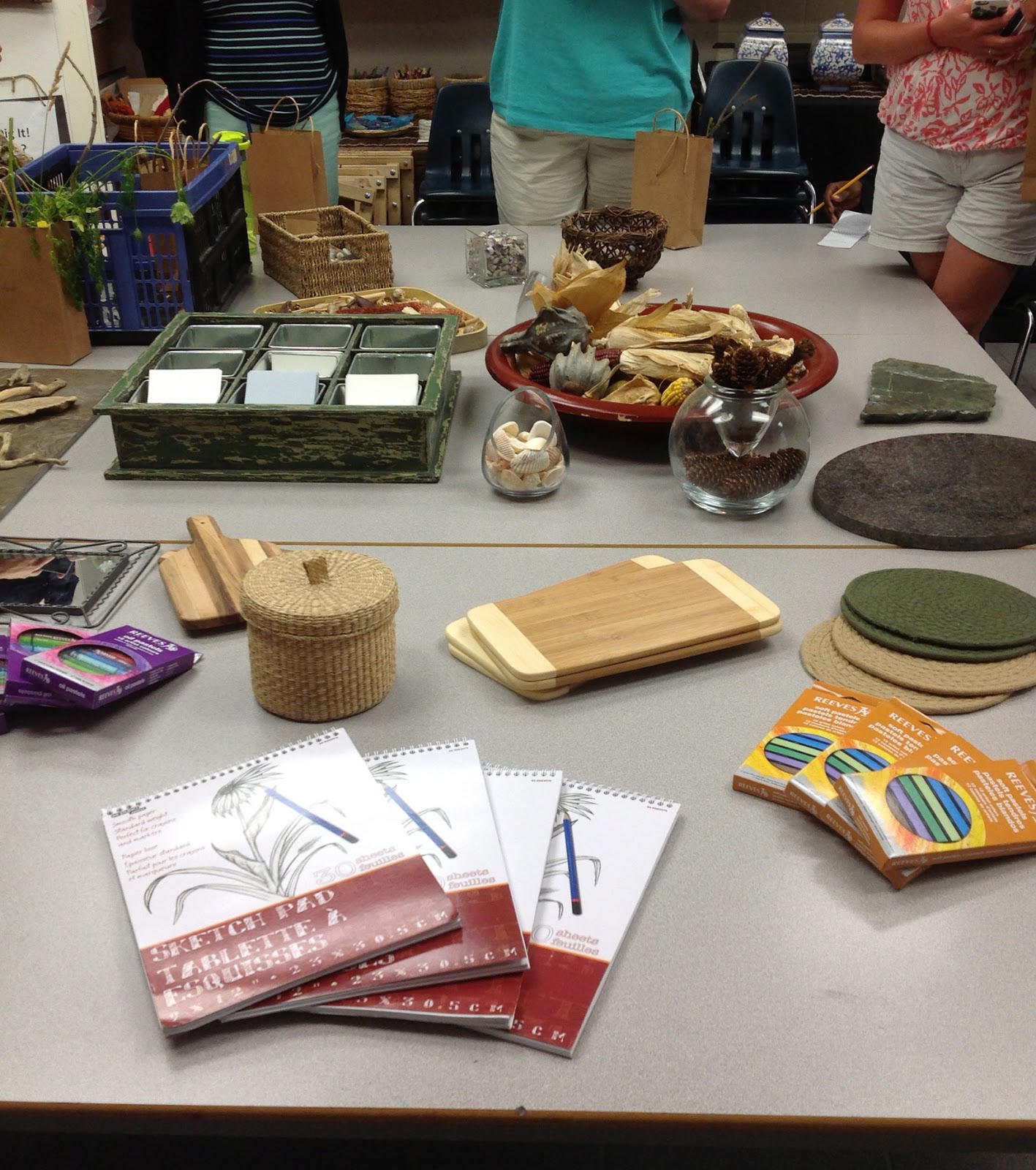
After lunch together we gathered in the art studio or 'atelier'. The wealth of materials in that room instantly impressed me. Everyone seemed to let out a gasp upon entering to see our first invitation to play: tables laden with art materials and loose parts, shelves bulging with jars, works in progress, and materials to touch. Walls covered with beautiful creations and provocations such as the lovely books above. We each found our little brown bags with the natural materials we'd gathered on our walk that morning, and soon we would be invited to use our found items with the materials present on the tables to explore the elements of design: line, texture, colour, form, rhythm, balance, and more.



Before we burst open our bags and pored over the goods all around us, though, Louise brought out a book to share. I couldn't help but smile, because it was the artist whose works have inspired me since I first learned about him in teacher's college many years ago. I've written about his inspiration several times now. Andy Goldsworthy's ephemeral art work features natural materials in outdoor environments. His explorations of the features of water, ice, grass, leaves, stone, wood and more often seem impossible when first looked at. It is his ability to awe that leads me to use his works as provocations for my students, and when playing with adults in exploring loose parts art. His materials also often leave no trace, so when the moment is gone, so is the experience. This type of work, the process being valued over the product, is the reason his creations always seemed so subtle and yet so outrageous to me. His works have oft-repeated forms (spirals, concentric circles, parallel lines, waves, sharp edges) that show up in an amazing array of natural materials, some arranged so poignantly that one can't help but wonder at the audacity of the artist to try something so difficult. I felt a connection to the activity, the book, and indeed to Louise as she explained her reasons for sharing this particular artist. 

Louise smiles as she finds another image to "wow".

Thus inspired, we participants opened our gift bags and began to explore the materials anew. The room took on a hush as everyone got deeply involved in creating something beautiful. Most chose to work alone, but as Julie and I had gathered together we chose to work together. We found a particularly inviting stump on which to work, and there we created our multi-sensory mandala. Once finished, we looked around at the wonderfully unique creations taking shape all around the room, before moving on to the next invitation, which was to capture in 2 dimensions an image of what we'd made with 3-dimensional materials. Before reflecting on the meaning of this next phase, I'd like to share some of the images I captured. One of the things that struck me as I looked over the tables was that the form of the creation almost always took the form of the chosen frame or backdrop. It seemed as though we each found a frame or a place in the classroom that showed potential, and let it steer the direction of our placement.
*Because I was so enthralled in the task, I didn't manage to see all of the work happening around the room. I am grateful to the Reggio PLC photo sharing, and have credited several photos here when not my own.


Our mandala, ripe with the scents of flowers and nuts, rich with the contrasting textures of soft stones and prickly bark. For me, working with materials involves using all my available senses, not just a visual aesthetic experience.


Reggio Inspired PLC deeply involved in our task.


Photo credit: Helen Chapman

Photo credit: Kristine Brown

Dawna's drawing seemed to me to be even more beautiful, more lifelike, than the sculpture it was based on. Photo credit: Kristine Brown


 This activity made our own learning visible: moving from one way of interacting (gathering outdoors) to another (playing, organizing just so, to create something beautiful) and then drawing (using pencils, markers, charcoal). This was an example of just a few of the hundreds of languages of experience and understanding we have as humankind. In working in multiple languages, we deepen our understanding of the materials and our motivations for using the materials (including choice of framing element). Thinking about how to represent our structures was like thinking about our thinking - reflecting upon our choices again and again made certain we would remember this activity for a long time to come, and be able to relate to why it was so powerful. I understood the poem more than a little better at the end of the day. I especially appreciated that Julie and I worked together, because it made the last step so fascinating: we looked at the same object and yet came up with such different representations. The details I chose to focus on were so different than hers that our results were naturally unique. The way that each work seemed shaped, directed in a way by the placement of materials on a frame (a circular mirror or stump, rectangular board, on the wavy grain of marble, the organic curves of a piece of stone) was once again an echo of that post-modern idea: the way you see is deeply swayed by where it is you are when you look. Your environment shapes your responses to experience. In a very real way, this activity allowed us to interact with our environment. For someone who has long ago given up the idea that each teaching has "one right understanding, one set of right answers", this process was very rewarding to see unfold. 

My picture, on the left, with the emphasis on the concentric circles and the lines within each element of the piece. Julie's picture on the right captured the colours and textures first, including the rich brown background of the stump. By choosing different materials to represent our sculpture (I drew first then added colour, Julie used the pastels straight away) our representations came out rather distinctly.

This activity, on the surface, might seem to be solely an artistic exploration. But that is missing the many languages or modes of thinking and acting we were able to play with on this day. For me, a sensory aesthete, my primary modes of learning were activated from beginning to end. Within our group we had artists (you need only look at their representations to see this!) for whom translating the experience onto paper was not a difficult task. I always feel a bit stunted, like I have two left feet, when trying to capture an experience this way. A camera in my hands, or words, and I can tell you in great detail how I felt. My musical family might share lyrically or melodically. Participating in the activity in many ways, then, allows us to tap into our strengths and also experience new,  less familiar ways to express ourselves.


 I leave off this post with the response I posted on the "Technology Rich Inquiry Based Research" blog post about the course. I read it again this week and realized it captured the elation I felt when I realized how transformational the course had been for me. 

"What you gave us in structuring a week of “messing about” was invaluable. I read above your description of how some participants expressed initial discomfort with not knowing the direction of where the play would lead. What the provocations (instead of “lessons”) do so brilliantly is to allow each player to interpret the meaning and relationship between various materials. This, unlike the PowerPoint or teacher talk, doesn’t trigger cognitive dissonance. I mean, hearing about how to structure your classroom in a way so totally unlike the traditional, perhaps comfortable method can’t help but trigger an emotional response, even amongst educators who embrace a playful day in their teaching. But giving us time to explore, touch, manipulate, talk, create, talk more, and play… is powerful. And then giving time to talk about it together, to reflect of people’s questions and noticings? Such good modelling for how we can do it daily in our classroom. Tying the theory in with our readings during debrief time made the theory come alive.
You all did manage to offer a course while following that most important idea: “nothing without joy”.
I’m sure I’ll read this again and see more, but for now, I just wanted to thank you again for a wonderful week. I feel very much at home with my ReggioPLC".


Thursday, 15 August 2013

a sensory walk with the ReggioPLC

Just as hot coals may continue to burn and glow long after the initial fire has gone out, I continue to process the wealth of learning that left with me when I said goodbye to my new friends of the Reggio PLC.  I left off my last post with the following words: "What followed (our introduction and tour of Acorn School) was both familiar and new, an invitation to explore the local natural spaces with the group and to gather materials for later exploration. It is a story for another post".

Traces of fall diffuse the light and cast intricate shadows on Acorn's floor.

A lovely invitation to read, look, touch, and investigate found items, at Acorn School

As we headed out for a walk together, we were invited to take along a small brown paper gift bag, a clipboard and/or our own digital device. We were off to see and gather anything that captured our fancy, while being cognizant of the life we might impact (something to revisit often with students while outside, or even in when insects visit). One thing that made our walk all the more delightful was that our school hosts joined us for the first part of our walk, with the group of young campers at the school that day. There is a lovely path through the woods beside Acorn School which meanders along, crossing a stream and then up a stone-lined curve to end at a neighbourhood street. As we walked, our pace was set by the fact that we were adult learners and thus able to set our own pace. Some kept pace with the campers, watching and listening in on their wonderings and observations. Some of us dawdled, finding interesting flora and fauna in the nearby gardens, and listening to the birds overhead. This leads me to the reason I love this introductory activity, and why I think our facilitators Louise and Diane set this learning invitation up so brilliantly. We learners, kids and adults alike, were setting off on an adventure. We didn't know exactly what we would see (you never do, when flora and fauna are involved) but we knew we would be gathering artifacts to share and investigate further, later. This was an invitation to look, listen, and use all available senses to experience summer under cover of trees. But it was also much more, from the perspective of the teacher as learner. For what can you learn on a walk? 

The campers, ahead out of sight, and many of us adults, watching and listening to the river below us.
 I stopped a while on the bridge, watching the water bubble against the rocks and swirl in little eddies against the edge. A few boys were watching the same spot, dropping leaves into the curling eddy below us. The leaves kept getting caught there, unable to escape the swirling pool to continue downstream. I was fascinated by their attempts to launch the leaves further, to touch down past the "stuck" spot where the faster water would sweep them away. I didn't talk to them at first, only watched and listened. I could see them trying new strategies and different shaped leaves. I tried my hand at tossing a few leaves as well, and found it difficult to affect the drop. There were many of us on the bridge at the time, and the sounds were quite noticeable: pounding feet stomping out a rhythm, water against stones, birds calling nearby, voices in conversation, gentle splashes of sticks and stones landing in the stream. I forgot for a moment my teacher role, so immersed was I in the play myself, that I didn't write or otherwise record their conversation. I wish now that I had captured some of what those two boys were saying to each other as they played. That magical moment passed, words undocumented, swept away like the water below. The campers headed back to school, and we continued along the path into a clearing surrounded by many types of trees and tall grasses.

Talking, noticing, listening, capturing interesting images: all choices in how we learn.

I reflected on this first day and realized that this activity is something I've done with my own classes many times. I have also gone on gathering walks with educators, including recently when fellow Reggio-inspired PDSB teacher/blogger Serge Pascucci invited me to bring loose parts nature play to his summer Kindergarten AQ course as a guest presenter. That day in July, our large group took a stroll down the lovely "Philosopher's Walk" at U of T to gather natural materials for later use in collaborative artworks. What struck me, however, is that I hadn't realized to what extent this is a powerful activity for observing learners. With Serge and his class, I was chatting and enjoying the beautiful setting, but also very self-aware in my role as leading a workshop on my own for the first time. In addition to this, I was catching up with someone I had known at a distance for some time (through following his blog, through social media, presenting at the same PDSB Kindergarten conferences, and through sharing pieces of a collaborative inquiry project between our classes in May), but had never met in person. With my students, this activity has always been done far enough into the year that I have gathered signed permission to leave the immediate school grounds for each student. Later in the year means I have already observed each child in a variety of classroom and yard settings. I know them, at least a little bit. I spell this out, because I think it's partly key to why I hadn't noticed how much you can learn about children by giving them freedom, space, and time outside. Mostly, though, there is something to be said for the manner in which Diane and Louise presented the big ideas of the Introductory Course to Reggio Inspired Practice.

A particularly beautiful moment in time: mist, spiderweb, delicate fern-like plants, shades of green. Others missed it, surprised by the photo later. Likewise, I saw images in others' collections and marveled at what I'd missed.
 As I outlined in the previous two posts, there was so much time and space afforded us learners to follow our interests. We weren't immediately sat down with a slide presentation about the beautiful schools and wonderful pedagogical insights from Reggio Emilia, nor were we made to feel as though we were in a heirarchical relationship to the teachers in which we had to listen and learn from their wisdom, though they both have much wisdom and knowledge to share. This was something new, for me. I have to admit, I love professional development to the extent that I was a bit broken-hearted when my Kindergarten Specialist AQ came to an end. Collaborating with others, especially those passionate about learning through play, is very rewarding. My instructors and friends from that class remain extremely important in my journey to embrace emergent curriculum. But I had never experienced anything like this, loose in time structure but incredibly rich in materials and experiences. We were honoured as capable learners, invited to participate in the 'uncovering' of the ideas together. We were immersed in delightful activities, and often directed to notice and share when some particular spark caught their eye. Even then, not every participant took part in every learning story, as we were free to rush off or dawdle as our fascination dictated. There was no one "take-away" we all had to leave with, unless it was the post-modern idea that there is never one simple truth, one must-learn lesson from an experience, always multiple perspectives. My lasting impression is that our own self-regulation was a perfect model of how students thrive in our classes. The image of the child in Reggio Emilia schools... brought to life in our adult community.

My clipboard laden with all manner of textures, shapes, and smells. Instead of drawing or taking notes, as intended, I came back with this collection of natural objects. Photo credit: Diane Kashin

When I go back into my classroom in a few weeks, I will bring this lesson with me. While exploring outside, students are much freer to show their true selves. They don't have to sit close together and keep their voices down, like at a meeting time in the classroom. They don't have to keep curious hands and feet stifled, but instead may step where they wish and touch what they wish, with safety in mind. An observant educator will see many aspects of a child's personality while they explore outdoors: are they fearful of bugs? Do they stomp on ants or gently step around them? Do they point out interesting items to friends or simply watch on their own? Are they calm? Excited? Do they have good balance and spacial sense, or do they trip over obstacles and tumble off of logs? Do they need to share what they see with you, or are they happier to explore silently? Are they interested in water, or trees, or birds, or patterns of light and shade? Are they boisterous and in a hurry? Are they able to transition back to school? The list could go on indefinitely. These are all possible to notice when taking a walk with children. Now imagine you add a degree of difficulty and/or interest to the walk, such as strong wind, rain, cold, heat. Think of how the self-regulatory skills and needs of students might be observed in these different conditions. These are the thoughts that came to me, looking over our photos, and thinking of my own children when we spend time outdoors. Tapping into such experiences allows students to access their prior knowledge (puddles, without rain boots, means wet feet!) while also adding new noticings (grasshoppers fly!). Collecting artifacts, such as we did with our little gift bags, allows for revisiting the experiences and seeing the items in a new light, when invited to use them for sharing or creating. Sharing the collections, talking about what one gathered and why, is another way to honour students' ideas and encourage them to use more of "the hundred languages" of children. That is what we did, our PLC group, after lunch together at Richland Academy. Another day, that story.

Note: if you are one of the participants from the week, I would love to know what your main "aha's" were after this first day of our Reggio Inspired Practice course.


Monday, 12 August 2013

reflections on learning in the Reggio PLC


Rosalba's joyful interpretation of L. Malaguzzi's words. I stopped in awe when I saw it.
A full two weeks since I attended the "Introduction to Reggio Inspired Practice" Summer Intensive course, I am still feeling buoyed by the excitement of this transformational learning journey. Back home, talking to colleagues and friends about what made this course so different, I kept coming back to two things: the community, and the environment. Now, the readings and provocations were wonderful, but the same materials in different hands would not have resulted in the gilded experiences we all had. This alchemy was made possible by the professional combination of Diane Kashin and Louise Jupp, two fearlessly unconventional professors whose depth of admiration for and knowledge about the Reggio Emilia schools is clearly evident. When they speak of the founders of the Reggio Emilia movement to transform schools, it is as though they are speaking about treasured lifelong friends. This passion for the subject at hand would not be enough to make these teachers stand out, however, for who hasn't been to professional development and left overwhelmed by a died-in-the-wool presenter who manages to make the task goal seem unattainable? Upon reviewing the photos I'd taken, I was struck by how few photos I had managed to take of either Diane or Louise "teaching". There they were, here and there, playing with light, taking photos, smiling, talking to kids, indistinguishable from the rest of us learners.

This, to me, was a light-bulb moment: they designed and facilitated the course as a model for how we teach when we're at our best. In a classroom full of diverse learners, it is never possible to meet the immediate needs of each, all at once. It is, however, entirely possible to set up a community of learners who take care of one another, who respect another's needs and interests, and who collaborate with shared ideas, materials, and efforts. And so it was, on the Monday, that we participants arrived from near and far, and we were warmly greeted and made to feel welcome: welcome to stop and chat with friends we knew only online, or to start with the beautiful breakfast spread out in the kitchen, or to take a tour of the Acorn School building and grounds. I stopped for breakfast, needing to eat but also to put names to faces as people came in. A socially curious person, I am not able to tune out interesting, new people in my vicinity even if the aesthetic environment is engaging. Others quickly walked off for a tour, pulled by the exquisite creations and documentation adorning every wall and available space. We were not rushed in, gathered together to sit and listen to "our teachers". Hmm. I've been doing that every year, having students say their emotion-filled goodbyes to families, and then gathering for a song circle on the carpet right away. Certainly I need to take attendance, and then I like to come together in a silly way to show that it's a fun, safe environment. Now I question that need to rush together and count heads. A classroom that is a place for wonder invites exploration. Surely I can take my time, let new friends explore the room, perhaps asking the seniors to be tour guides, offering assistance and helping to mark out boundaries and safety concerns when they come up.

The first of hundreds of photos I took over the week-long course. The atelier at Acorn quickly captured my eye.

What happened that Monday morning is that we were welcomed, given what we needed (food, directions, clarification), and then allowed time to explore as our curiosity demanded. When we did come together, all squeezed together in the lovely Kindergarten room, we followed the conversations we'd struck up while exploring. Everyone seemed to be engaged in talking to a new friend, chatting and sharing observations about what they'd seen that morning. We were introduced to our partners in the learning, the wonderful staff at Acorn school. I don't recall much of the introductory conversation, as I was beginning to reach sensory overload with the multitude of invitations all around me, including above my head. And that leads naturally to the second aspect of the course that made it so transformational. It is an oft-heard phrase: "the environment is the third teacher". The first time I encountered that phrase, perhaps three years ago, I thought of environment as the static make-up of a room: the shape, the furnishings, the windows and doors and such. It took years of reading and hearing about Reggio Emilia schooling to grow a more nuanced understanding of the phrase, one I assume will change again as I continue to reflect upon my practice. Now it seems to me that the environment is a living space, a structure but also the elements within the structure: light, space to move, living and non-living materials, textures, colour, sound, feel. Then the phrase took on more meaning this year, as I began to see the sparks and provocations of daily class life as part of the environment. By bringing us together at Acorn School, our hosts were inviting us to play. Before I can describe our first invitation, I would like to share some images to explain why it is I could barely sit in my seat. My curiosity surrounding new colleagues piqued, coffee consumed, introductions made, now I began to crane my head like a child at a parade, unable to see everything and practically jumping out of my chair to go touch something. I hope the photos are able to capture some of the engaging nature of this wondrous place.


In the Kindergarten room at Acorn school, invitations to explore are everywhere! Those above I could see before even leaving my seat, along with an intriguing chart about planting a rainbow which I included below with the garden it resulted in. The rest of the collages required a walk around inside the school.


A note about the photos above: I was watching everyone walk around, admire, even look inside the mirrored triangle. I couldn't believe they could resist the temptation to get inside. I certainly couldn't!
Julie (upper right; she crawled in after me) took the middle photo. It is an amazingly simply piece of furniture (and Rosalba later told us the story of its creation) that leads to such wonderful observations about perspective, point of view, image of self, light, colour... a place for wonder.


A conspicuous absence is the engaging documentation everywhere in the various classrooms. In order to respect student safety and privacy, none of those images are available. I did want to share the environment, though, because it is here that I see those two familiar ideas come to life to beautifully: nothing without joy, and the environment is the third teacher.
What followed our free exploration was both familiar and new, an invitation to explore the local natural spaces with the group and to gather materials for later exploration. It is a story for another post.

Friday, 2 August 2013

saving traces of a most incredible week


Gifts from the ReggioPLC community at the end of our week. These will have a treasured spot in my classroom when I return.

 Last week I had the good fortune to attend what I can only describe as the most meaningful professional learning opportunity I have ever taken part in. Friends who follow me through social media no doubt already know what an amazing time it was, as they have watched the week unfold through twitter pics and snippets of conversations shared on vine. Anticipation started months ago when Diane Kashin and Louise Jupp, two people I respect and admire (and follow through various social media), posted the flyer for their new "Introduction to Reggio Inspired Practice" Summer Intensive on their blog.

Friday, one week ago, I was saying goodbye to a group of friends I'd only made acquaintance with (in most cases) on that Monday. Some in the group were friends already, but I simply hadn't yet met face-to-face: such is the power of a good twitter PLN. Diane and Louise felt like friends already, from conversations shared about deeply held convictions, both on their Technology Rich Inquiry Based Research blog, and on twitter. Their though-provoking blog, Pinterest boards and tweets are the way I continue my learning which simply couldn't come to an end when I finished my K Specialist AQ this spring. Also in the group, Julie: a PD friend who also took that K Specialist course with me and who is uniquely linked to my students, class, and K team: "Miss Metcalfe" taught in room 109 until last year when I moved in. Her junior students, who became my seniors, loved for me to share photos and stories with their beloved teacher. Another friendly face was recognizable: Helen and I met when she attended the "Sticks and Stones: Collaboration with Nature" workshop that I co-presented at the Peel Kindergarten Conference back in May. As a testament to the way that the learning unfolding, I felt as though I had known all the participants for ages when the week came to a close.

For me, summer home with the kids has meant road trips, visits, and many little outings to the beach, pool, or parks nearby each day. I am not yet ready to sit down with all the photos from the week, to tell the stories in a way that does justice to how beautiful and affirming this course was. I do, however, have a picture story to share. The final day's activity was creating and sharing documentation, and that is what I will share here. I've edited a few pages for errors or where omissions were obvious, but left most intact as it was created on the fly in our busy classroom last Friday. It surprised me to re-read it today and see so few pictures of the coordinators of our course. I now think that it reflects how well Diane and Louse embody the practice that they wished to impart: learners and teachers co-constructing learning through shared experiences, not a one-way transmission of ideas from those with all the answers. I was also struck by how I managed to tell an intensely personal story, when I worked to document my own learning as opposed to that of my Kindergarten students. It was difficult to say goodbye when it all felt so much like home, and that came through in my pic collage story. Here, then, is a glimpse into my learning from the first Reggio Inspired Practice summer intensive.


A note: I do hope to share some of the stories of my new friends, through links if they create their own blog reflections, or through a "visiting" post here on my space. Let's keep the ReggioPLC growing!

Adding to the story:
Introduction to Reggio Inspired Practice: Participant Reflections

Reflections on the Reggio Professional Learning Collaborative Summer Intensive

What it Means to Collaborate: A Teacher’s Reflection

More to come!


Wednesday, 17 July 2013

We can see birds, part three

I am fully in summer mode these days: the family and I swimming at the outdoor pool or nearby beaches, taking evening walks when the air is cooler, riding bikes and visiting friends. While visiting a friend and former teaching partner at her family cottage with the kids, my son and I went out for a paddle around the bay to look for the loons we knew to be around from their frequent calling at night. When we came home and I uploaded the photos, I was reminded of the magical day, back in May, when a walk with my class turned into an ornithology field trip through our local school environs.
Pause for binoculars: stopping to look at the loon in the bay.
Another day, a gathering of adult loons was surprisingly tolerant of us stopping to watch them.
Several posts back, I shared the story of one of our larger inquiries of the spring, including several smaller projects: birds became a major research topic for both my morning and afternoon classes.  Now, we Thornwood Kindergarten teachers are a sharing bunch, so news of what is happening in one class soon ignites interest in others. Ms. Croft sent a tweet or called on many occasions when one or more of her students wished to share their birding news with our class or visit to "consult the expert" (me with iBird on my phone) to hear what a given bird might sound like. The last post I shared, part two, was more of an overview of how the project unfolded in various areas in the classroom over time, including a look at how students were developing their inquiry skills through many self-started small group projects. I mentioned one particular day, however, that stands out as a day many students will remember:
"Last week, the morning friends and I went for a walk with our friends from down the hall: Ms. Silva's class. We had some exciting encounters, some of which are sure to show up in our Voicethread. The story of our bird-watching walk, along with some of the individual "I Can See Birds" books, will be the subject of part three".
That morning we packed our wagon with the usual must-have kit for walks: a bag of tissues, bandaids and hand sanitizer, plus students' personal water bottles. We also packed my old, dog-eared bird guide, binoculars, clipboards and pencils, and my phone with iBird (still the best birding app I know and worth $5.99). Our friends followed us across the bridge over the creek to the path we started listening in earnest to the birds around us. Now, having studied our local birds for months now, many of the students could identify the calls or songs of robins, blue jays, red-winged black birds and ring-billed gulls (all frequent visitors to our grounds). 

Ms. Silva's class by the bridge, gathered close to look and listen to feathered friends.
Watching and listening to the red-winged blackbirds and chickadees responding to iBird.

I knew from previous experience that some songbirds are more likely to search out the sound when they hear their songs or calls played or imitated. Nuthatches are very curious little creatures, so when I heard one "beeping" away, I gathered everyone close to see if we could call it down close to us. I couldn't have orchestrated a better response. The bird flitted down over our heads, called to us, flew from one tree to another over us in low, swooping arcs, and wasn't the least perturbed by the gasps and waving hands from the students below.

Crouched down low to observe the nuthatch.
While I played the nuthatch song, our heads swiveled back and forth as the little bird flew from one side of the path to the other, always answering. The students were enthralled, as I was. Several students wanted to capture the moment, and asked for photos (thank you to my lovely morning T.A. Mrs. P., seen above as the shadow hands holding the iPad, for taking the photos and encouraging the students to point out photo subjects!) but also grabbed the clipboards and got to work. E's fantastic eye for detail meant that he captured many of the field marks one looks for when identifying a red-breasted nuthatch: the funny downward posture, black cap, rust-coloured belly, long, thin bill. All this captured while the bird was in near-constant motion. S, meanwhile, began compiling a list of each bird we heard or saw during our walk. The list grew so long she had to flip the page over to write on the opposite side. Both students demonstrated how motivated they were to capture the experience for sharing later. Both artifacts and many more from this trip wound up in our "We Can See Birds" Voicethread (click to play) book.

E's observational drawing of the nuthatch.
S writing out the names of birds seen on our walk.
As we walked further down the trail to the bridge to take us back over Cooksville Creek to our local park playground, we continued to look in the trees and the sky for birds. 

A student requested I take this photo, saying: "Look! The plane is flying, and the bird is flying!"

The creek: sometimes meandering, sometimes forced straight by concrete causeways, is a wonderful place to investigate human activity and its impact on the environment. In spots where the water is forced to change its path, whether by change of level or a stone-filled section of rapids, litter is frequently found. Plastic bags snag on low branches, and all matter of trash gathers in swirling eddies or bubbling froth. It can be difficult to relate to air pollution, even for adults, but water pollution can be so very visible, and students notice this blight to their beautiful environment.


Peering at the pair of mallard ducks below.
Looking at the water, observing the trash. Note "E" holding the clipboard in her hand.

Studying the local outdoors is a huge source of inspiration for the science curriculum in Kindergarten. Wondering about how the ducks and other creatures manage to live when their water is full of trash is a question that could easily lead to an entire year's worth of inquiry projects. It is unfortunate, perhaps, that we were so close to the end of our year when so many students became concerned about littering and pollution. It is very fortunate, however, that only half of those students will be on their way to grade one in September, so the possibility of following these interests remains for next year.

From the Science and Technology expectations in the FDEL-K:

"Overall Expectation 3: demonstrate an understanding of the natural world and the need to care for and respect the environment

3.1 identify similarities and differences between local environments (e.g., between a park and a pond;
between a schoolyard and a field)
3.2 describe what would happen if something in the local environment changed (e.g., if trees in the park were cut down; if the pond dried up)
3.3 identify ways in which they can care for and show respect for the environment (e.g., feeding the birds in winter; reusing and recycling; turning off unnecessary lights at home; walking to school instead of getting a ride)".
Full-Day Early Learning - Kindergarten Program (draft) p. 121


We saw and heard many more birds on our walk back to class through the park. A particular highlight, though nearly impossible to capture in a photo without my zoom lens (at home that day), was a turkey vulture soaring over our heads towards the school. We followed it back, and after a period of play and snacks, we gathered together for our "share time" before heading home. Naturally the topic for sharing was all about what we had seen that morning.

J and S read the long list of birds we saw on our walk.

A red-winged blackbird.

 E drew her observations on a clipboard: ducks, nuthatch, and woodpecker are pictured.

My old, well-loved bird book: a gift from my parents many years ago. This book is even more precious to me now that my students have treasured it. F, my go-to "bird expert" in the PM class, surprised me by identifying the birds on the back from another bird guide. "They're hooded warblers", he said. I actually had to look it up to see that yes, he was correct. Warblers are notoriously hard to identify. Way to go, F!

This morning was another example, for me, of how important it is to take the learning outside. Not trikes and balls in the play-yard, though there is time and reason for these as well, but real exploration of what is happening just outside our door: this is planning in Kindergarten. I sign off now to go hop on my bike. To those in class for whom I promised this story: better late than never!

Sunday, 23 June 2013

We can see... the end of an amazing year!


As we come to the end of this year, my first year at my new school, I can not help but look back in awe at how much we have accomplished in a short ten months. My classroom became a home, and my students became a caring community. Students who were nervous to try new things blossomed into true risk-takers, often teaching newly-learned skills to their peers. A student who was silent at school for nearly two years found his voice, to the delight of his classmates (and his teacher!!!) with some truly fantastic support from his family. I include myself in that group: my professional annual learning goals including becoming more connected with teachers, students families', and with the greater school community. I can't help but smile as the last of our wonderful Kindergarten team here at Thornwood joined twitter and immediately saw the power of the amazing PLN (professional learning network) to share ideas and further our professional learning conversations. This blog, started back in the busy winter when I was finishing my K Specialist AQ and still sporting a cast on my broken wrist, has taken me deeper than I thought possible into reflecting upon my practice and the learning taking place in our class.


But I think the thing that changed me and my classes most of all, the thing that makes this year so different from the eight wonderful years of Kindergarten in my former school, is what happened when our class joined the "We Can See" project blog back in the fall. I discussed this back in an earlier post "We can share our stories" talking about how quickly students began to write for an audience of their peers. Even earlier in the year, two PM class girls sparked a counting project when they shared with me how they could count to ten in their home languages: Mandarin and Farsi respectively. This led me to record them counting, share with both classes, and start a "We Can Count!" Voicethread book (click to play) project. This book grew over the year and, in fact, a new student recently joined us from Japan, and he has agreed to join the book during this, the last week of school! This project well demonstrates how these students have a well-developed sense of identity and self-image (see the #1 expectations, below). Not long after starting this book, I learned about the "We Can See" project blog, and I knew it was a logical extension for my students who already knew that their words and images had an audience in the school and at home (through my class site links). I was right: the project was hit!
Not only do students understand that their works are being seen by peers and other followers, such as parents and Kindergarten teachers in Ontario and beyond, they also enjoy writing back to their far-away friends about the projects they see on the blog or on twitter. Together we have learned about different types of responses, and as such students offer a comment, a connection, or ask a question of their friends in other Kindergarten classes. Social media is such a prominent part of our lives, so it makes perfect sense to introduce students to responsible internet use (netiquette) while also meeting several of the expectations from the Personal and Social area of The Full-Day Early Learning–Kindergarten Program.

As children progress through the Full-Day Early Learning–Kindergarten program, they:

(Overall Expectation 1): demonstrate a sense of identity and a positive self-image
1.1 recognize personal interests, strengths, and accomplishments 
1.2 identify and talk about their own interests and preferences
1.3 express their thoughts (e.g., on a science discovery, on something they have made) and share experiences (e.g., experiences at home, cultural experiences) 
 
(Overall Expectation 3): demonstrate a beginning understanding of the diversity in individuals, families, schools, and the wider community
3.3 talk about events or retell stories that reflect their own heritage and cultural background and the heritage and cultural backgrounds of others (e.g., traditions, birthdays, cultural events, myths, Canadian symbols, holidays)


Full-Day Early Learning - Kindergarten Program (draft) pp. 58 - 62)

Back when I wrote that post "We can share our stories", I had begun by lamenting the fact that students weren't yet interested in making their own personal "I can see" stories. This is no longer true, as my Peel site now has a nice long list of Voicethread books for families to see and enjoy at home. My students are used to me taking two types of photos or videos: firstly, those that may be used within the class, which may include names, faces, and identifying features of those in the photos; secondly, those which exclude all identifying features so that they may be shared with twitter followers, our classroom site, my blog, or other forms of social media. Students are well-versed in my safety protocols and even remind me when I'm taking video clips to be careful around showing names on artwork. It has lead to some interesting conversations, then, when we see students in other classes creating their own personal "I Can See" books with very personal details included. I loved how they noticed these details and so we talked about the fact that in those particular cases, the teacher wasn't making a decision to break the rules. We read the "fine print" in those posts, and in those cases the teachers thanked the families for taking part in the project and allowing for their personal photos to be used. This lead to a conversation about "informed consent". Big ideas for young students, indeed.

Photo shared by Tijana's family.
It is with great pride, then, that I share my first such project with you. Tijana is a "butterfly" (or SK) in the AM class (JK students are "caterpillars" in my class). This means she is soon leaving Kindergarten. She is an artistic student who often shares her art work with us, asking me to take a video while she describes her creation, or sings a song for her class at share time. When she took a trip with her family to Florida during the first week of June, I asked her family if they would share any photos they took while away. They agreed, and sent me a link to the set of photos online. That same week, Ms. Schmidt's and Ms. Theis' Kindergarten class posted a new book on the shared blog, this time a book created by Taha in their class to share his trip to Egypt.  After our class read the blog and I scribbled down the many responses to his book, I mused how wonderful it would be if Tijana were able to create a book like that, too. Note: scroll down to the comments to see what my students had to say. The next day at school, Tijana showed the trip photos as a slideshow to her classmates, using the long pointer to point out interesting details from her trip. She did a wonderful job retelling her exciting days spent with her family. Then, with her parents' written permission, we set about creating her own "We Can See" book to share with our larger Kindergarten community and families. She and I worked together, a bit each day, to select photos, type messages, and record her story (link provided below). We didn't work every day, because of exciting interruptions such as outdoor play day, walks to the park, or days when I worked closely with other ongoing project groups such as our snail garden inquiry. I am very proud of her work and of all my students for the amazing growth they've shown this year. Butterflies, you are ready to spread your wings and fly off to grade one.

I want to say some important thank you's: thank you to Tijana and her family for agreeing to work with me in this way, and thank you to the families of all my wonderful students who signed the media release and my special Voicethread request form, and who share the books we make with family and friends around the world. Thank you to the wonderful administrative team at my new school who not only support my experimentation with social media, but who ask me to share my successes with others at school. Thank you to my fabulous, hard-working, always collaborative Kindergarten team at Thornwood, especially for all jumping in headlong into twitter with me. Water's fine! Thank you to Joanne Babalis for creating the "We Can See" project blog, and to Angie Harrison whose class project inspired Joanne to do so. You have all made this year incredibly special, one I surely will never forget. 

Thank you, reader, for reading along. Now please enjoy Tijana's book: "We Can See... Florida!" (click to open).

Note: If you try to open on a mobile device you may receive a pop-up request to download the Voicethread app. This isn't necessary, as you can view it through the web version (any browser will do). Try copying and pasting this link if the first option doesn't work for you: https://voicethread.com/share/4687927/