Showing posts with label making learning visible. Show all posts

Sunday, 30 March 2014

a lightbulb moment


A girl takes a picture of the project that started as an invitation to make music with water glasses, but quickly took a tangent to revolve around colour mixing, pouring, and "potions". Here she documents the process before adding more materials.

One of the wonderful additions to my ongoing PD journey has been the creation of the #ReggioPLC twitter chats, biweekly on Tuesday evenings at 9. These fast-moving conversations are nimbly led by the wonderful hosts Louise Jupp and Diane Kashin, whose thought-provoking blog posts and Reggio-Inspired Summer Intensive course grew my practice and my PLN exponentially. (see last August's posts for reflections on the wonder that was their inaugural intensive course, and see here for details about this summer's course). One theme that comes up often is the idea of welcome "cognitive dissonance" after these brain-stretching conversations about pedagogy, understanding students, documentation, and more.

I understand the reason people keep calling it cognitive dissonance: it does sometimes feel as though my brain hurts after a good hour of challenging my own and others' ideas. Such speed, like watching professional ping-pong, these concepts get bounced back and forth and tangled into our own stories and argued through various viewpoints. I don't, however, think it is dissonance for me. That would be uncomfortable, leave me feeling like I had been wrong, or mislead, in my thinking. Instead, I think what happens is that a light goes on, and shines on ideas I hadn't quite seen fully. I see more pieces of the puzzle, as it were. I see a bigger picture.

The light bulb has become visual shorthand in my class this year: when someone has an idea, they often run and stand under this light bulb on the chalkboard, as I did here when something a student said at meeting time gave me a big idea (and another student took my picture).

In my last post, I examined the history of celebrations as curriculum in my own teaching practice over the last decade (which I've had the good fortune to spend entirely in Kindergarten). I was nervous to share my conflicted feelings about using certain holidays as teaching topics, because I know many great teachers whose classrooms are full of learning and who do celebrate every holiday with true Kindergarten gusto. I didn't want to leave anyone with the impression that I judge others for using popular cultural days for material for teaching: if anything, I wanted to explain my reasoning for why I often don't but really have no set rule. I argued in that post about the meaning of St. Patrick's Day, an old religious holiday long since stripped of its religious meaning in popular culture, (though not in that of my Northern Irish in-laws for whom it is a day full of music and lively celebration) now a day full of single-use, disposable celebratory cups, decorations and wearables. I shared my discomfort with the waste, the teacher-created crafts that students merely follow in step-by-step manner to create a product (thus minimizing the valuable process of the creation), and the lack of connection to the big ideas in our kindergarten program. Royan's comment after the post sums it up better than I did in so many paragraphs before:
 "I certainly don't have any answers, but one question I usually ask myself is, "Is the [fill in the bank] celebration externally driven, or is it something the students in my room deeply want to celebrate for intrinsic reasons?"
So it is I'm back with a provocation that stopped me in my tracks, one that I instantly saw as creative, brilliant in its invitation to play with materials. I would use this with my students without reservation.
I'm grateful to MG for letting me quote her class twitter here.


There is the lightbulb moment: not dissonance, for it doesn't undo previous thinking, but instead brings it clearly into focus. In this invitation students are challenged to look closely at the form in order to find a way to reproduce it. Creativity is not stifled, but called upon. This is what our kindergarten program asks us as educators to do, throughout all the strands in all areas: identify what children know or need to know for what they are focused on, and extend their thinking with good questions and provocative materials.

What I love about the ever-growing PLN on twitter is how often an idea shared by other educators (Teachers, ECEs and others in this group) connects with interests I've seen in my students, or the way glimpses I've shared on my class twitter resonate for others. Sometimes I catch these stories mid-way, once they've already been taken up by the students in a class. The example below is one that stood out this week: a simple game (one I know as "snap" or "war") becomes a complicated ritual, a spectator event, a reason to record scores, and all student-led. I'm grateful to Kristen Enfelis (@KEnfelis, DECE in FDK) who kindly allowed me to share this conversation:


(I jumped in here too, hence the answer to both of us below).


There was a student-initiated project shared this week, too, one that helped me appreciate more keenly the role of the educator in an emergent curriculum classroom. This was shared by Nancy Niessen, a teacher who has inspired me greatly with her outlook on teaching through her thoughtful posts. So often since I joined twitter (a mere year and a half ago) I have found myself nodding along to Nancy's musings or observations from her classroom. Being a half-day Kindergarten teacher in Ontario is being a part of a rapidly shrinking group, one with no more members once the last schools like our come into FDK next year. Her additional insight as an AQ instructor for ETFO for the Kindergarten Specialist always make for rich conversations in the #ReggioPLC.

In fact it was Nancy who inspired me to begin a second account for my class this year (and from there to convince the rest of my Thornwood team to follow suit). I have learned much from seeing the way Nancy shares with her family followers on her class account: how to invite conversation between students and their families (with photos of books read and the prompt: "Ask me about...") and how to make student learning visible in a way that truly celebrates the students' efforts. This example below is only one of many such celebrations.


Seeing materials bloom into different projects is a clear indication that students have ownership over the direction of their learning. Nancy is an exemplary model of a teacher who listens closely and provides direction for further learning. I thank her, as I want to thank all of my inspiring PLN, for daily enriching my thinking, and my learning.

I have many people to thank, including my students, for helping me move my practice towards a more celebratory, creative place for all learners. And so I invite you to look for people who help you see, whether a better reflection of your own practice or a clearer view of the big picture in education.


Monday, 23 December 2013

looking closely at life and learning


This week's ice storm brought a world of wonder. Even while branches and whole limbs rained down, sometimes tangling in hydro lines and thus plunging entire neighbourhoods into darkness, the strange beauty was an invitation to go outside and look closely.
Our big idea this year in class is "looking closely". In October I detailed (here) how this project began when Heather McKay noticed a spark, an idea, and turned it into a beautiful collaborative blog, and how this lens of looking closely fit me so well as a teacher and learner. Yesterday and today, walking along the ice-lined streets of my neighbourhood, I was struck by the beauty and destruction wrecked by the ice storm, and how the shock of seeing the world in such a different light causes everyone to slow down and look closely around them. The marvelous old oak trees that line my street, some so large their branches drape over the street and over the houses on both sides, suddenly frightening to walk beneath as they creak and shed ice in the breeze. Stubble in the garden of grasses or long-dead plants, ignored as drab, now stunning in a blanket of sparkling ice. Cold steel fences now dripping icicles, an invitation to strum, to shatter the icicles in a musical burst. Tiny leaves, still clinging to branches long after most leaves have fallen, suddenly gem-like as they shine like coloured glass.


Part of the reason the looking closely lens fits so well is that I've tried over the years to use this approach in daily life - early on through Shambhala (in brief: a meditation practice which begins with looking closely at one's breath, and the transient nature of thoughts) and later Miksang (a "contemplative art" practice of photography started by several Shambhala practitioners but practiced by many outside of the sangha. For a long time I thought it was something external to my teaching career, even though I've always been a reflective teacher, using my mistakes or misunderstandings to guide changes in my approach. Over the years it took me to complete my Kindergarten Specialist AQ, the idea of looking closely at myself as a learner and teacher became clear. My gradual AQ transformation included ideas from Project Zero's Visible Thinking routines, and my understanding only deepened when we further explored the inspiration of Reggio Emilia. Learning about the place, the people, and ideas from Reggio Emilia was also a homecoming of sorts, in that I realized where my first hero in Kindergarten Nancy Thomas (who I first wrote about here) had found her ideological home so many years before.

The quote that elicited a gasp when I first saw it on the wall near the light studio at Acorn School.

I wonder if the urge to look back at the year, to sum it up, comes from the fact that during the winter holiday break we can step back a bit from the classroom and think about all the learning that has taken place so far. It is also a natural response to looking through the year so far in documentation as I gear up to write the first term reports for my two classes, a process a wise twitter friend Tracy once likened to "falling in love" with her students (I couldn't agree more!). Looking over hundreds of photos and anecdotal notes taken since September, I can't help but see how this year, more than any other year before, the students and their ideas have become the curriculum. This is to say, I've begun to look closely at teaching and learning through a Reggio-inspired lens. Upon re-reading my "Looking Closely" post on the collaborative blog (included in its entirety below), I noticed how much we had explored the living world just outside our classroom door, how students observed and wondered about everything around them, and how adept students were becoming at noticing even the tiniest changes in their environment. I realized that while I believe I have far to go to and I'm grateful for my PLN for the constant inspiration, I had become the sort of person who a child will give their most precious discoveries to: a snail, a leaf, an interesting stone, an insect, a scrap of newspaper with something interesting, a drawing made at home. I think I always wanted to honour children's learning, but the trust my students have in my now tells me I'm getting much closer to the real thing.

The following was first posted on November 22nd on the "Looking Closely" collaborative blog (you may see the original here).

This week a student in our morning class, "M", made a banner for the bulletin board where students have been pinning the observational drawings they make at the "look closely" table. I am happy to scribe ideas and often write down entire conversations I hear during group discussions or "play and learn" time, but there are many times when I encourage students of all writing ability levels to "give it a go". Labelling drawings is often one of the first ways students start writing new words in our class. Creating a place for us to share those labelled drawings provides motivation to some students who would often only draw or paint, so I try to save spaces in our room for such writing. Here is what our "looking closely" board looks like today:


In our class we have been using the term "look closely" since September, applying the idea of slowing down and inspecting details in objects around us to all manner of flora and fauna, and other objects in our environment as well. In the three months since school began we've seen such great changes in weather and this in our surroundings. September began hot, and our days began with outdoor welcome circles spent sitting on the grass with dragonflies flying overhead. October brought cooler days, changing colours, and ripening fruit and nuts falling all around us in Thornwood plentiful trees and the wonderful long grass of the "no-mow zone". November brought us bare branches, leaf piles, and frosty mornings. Always something interesting to explore outside, almost always something interesting brought inside with us to further explore at our various nature centres. Students know that observation is a valuable tool, and as such they are always bringing something interesting to school: leaves found on their lawn, ladybugs or other insects found while crossing through the "no-mow zone", everyone's favourite: snails. I love that my students know I am the sort of adult that will treasure these items they bring, and that everything we "look closely" at has something to teach us or some wonder in it. Here are some moments spent looking, studying, wondering about the things around us:

Saying goodbye to a grasshopper we "adopted" for an afternoon after catching it in the long-grass of the no-mow zone.

Students were delighted (and some disgusted) by my exotic snack one day. A few select students recognized the fruit as being close to lichees and 'long an' fruit which they had seen before.


We found a cricket and some ladybugs on this walk through the no-mow zone, and brought them back to the yard to house them in the glass house for safe observation. Students were immediately concerned about the interaction between the large cricket and the smaller ladybug. Many wonders arose before we released both creatures, unharmed.

One of several such oak leaves brought into the class to explore up close.

Frost, like sunlit dew, makes every 'ordinary' thing in the world somewhat spectacular.
It's possible that you could hear our class from a block away, when one student discovered the gift of the milkweed pod and opened it up. White fluff filled the classroom as students shouted and tried to capture the flighty seeds. In retrospect, this is a provocation best shared outside.
One of the ongoing inquiries in our classes, both morning and afternoon, is surrounding our adopted trees. Having chosen our trees earlier in the year, students are now in the habit of observing not only their own class trees but indeed all of them around us. Several students have begun to curate their own projects, using the leafsnap app to identify trees by the leaves they find, or drawing the details they see in fruit, leaves, branches, nuts, or pine cones collected and inspected at the various nature tables in our classroom. I look forward to seeing more writing and deeper reflection as the students continue to apply "looking closely" to their environment throughout the year. I am grateful to this wonderful community and to Heather McKay for the (Frank Serafini) book: "Looking Closely Along the Shore" for inspiring this way of experiencing wonder with my students.
(end of original post).

Here are a few tweets from November and December showing provocations and student participation at the "look closely" centre in our class. M's banner for our bulletin board sparked an interest in documenting, through drawings and words, what students noticed when examining materials.


This month, the early onset of winter has brought even more changes and wonderment to my young learners. Here are a few snapshots of recent events and ongoing examples of what "looking closely" looks like in our kindergarten class.

Exploring tracks outside, recreating inside in sand.

One day last month, D and Z got an idea while playing at the water table: "Let's fill this bottle and take it outside!" They did, and within a few days I realized that they had created quite an interesting tool for inquiry about weather, temperature, and states of matter. The morning students quickly took notice and began to consult the "weather bottle" daily as well.
Inspired in part by D and Z's weather bottle and in part by my love of creating provocations with ice, we froze some balsam fir branches in various containers to explore in the sensory table. Above, we took one ice block to the light table to examine it closely there too. These were such a popular addition to the class that I suggested we use the containers again to create something to decorate our adopted class trees.


Afternoon students exploring the ice blocks and creating ornaments to decorate their tree.
The morning class ornaments hung from our beloved silver maple tree.

"Looking closely" at my class in this way, I see I've gone on for what could easily be two posts, and yet there's so much more to share: our tree inquiry, looking at the smallest creatures in our world, looking at growth and change in flora and fauna as well as ourselves... being aware, being mindful.


Monday, 26 August 2013

in the atelier: expressing ourselves in our many languages

As summer is coming to an end and I prepare to head back into my classroom to set it up for September, I know my time to share the story of my transformational week with the Reggio PLC is running out. There were four equally fulfilling days which followed this one, but Monday's journey was not quite finished when I left off last week's post with us returning from our walk in the woods behind Acorn School.

The final part of our wonderful first day with the Reggio Inspired Practice introductory summer course took place at the expansive, beautiful Richland Academy. My first post about this day looks a bit like a love letter to Acorn school, for indeed it is such an exquisite environment that one could easily get lost in the wonder. Richland Academy, just a 12-minute drive from Acorn School, is also a place of endless wonder. Our group did not explore the whole school on this or any of our days there, but instead were given glimpses of certain rooms. This was carefully set out so that we would uncover each new day's provocation as we came to "mess about" in that new room. It was a bit like an advent calendar of childhood: each day, awaiting a surprise behind another closed door.

The promise of honouring the learners which hangs on the wall where you enter Richland School.

 When we arrived for our lunch at Richland, one of the first things I noticed in the large, light-filled expanse of the foyer was the large poster pictured above. This poem has taken on more and more significance for me as I delve further into my understanding of the message that Reggio Emilia teachers are trying to share with the thousands of visitors and even more faraway readers. As I allow myself to follow the lead of my diverse students, as I listen closely to their ideas and learn to ask better questions to keep the ideas flowing, I find myself more and more in tune with my students. It is hard not to feel something akin to pride, even love, when you work so intimately with children as they invite you into their free-flowing creative thoughts. Anything seems possible when you are three, or four, or five. When you're open to this freedom, things that once seemed impossible to you as an adult slowly begin to look possible, and even likely. Reading the "Hundred Languages" helps me see the innate brilliance that children have in seeing things around them as they are, not as they should see them. A lost button or acorn cap or piece of string is not merely refuse, but a precious material to be saved, experimented with, treasured. A puddle is not a mere gathering of raindrops on the ground when you have rubber boots or a stick to float or a rock to drop. Testing the world around them is a children's very important work from an early age, and the poem cautions against turning the materials and places in the world into one thing each, one day of the year or one way of being used. So I paused to take a picture and read again, before heading to lunch. I thought: this is exactly the sort of school I'd like my kids to be at. I know now, after exploring much more around in the classrooms and outdoor areas, that it IS exactly the sort of school I'd like to send my children to, if we weren't so far away.

Photo credit: Julie Metcalfe


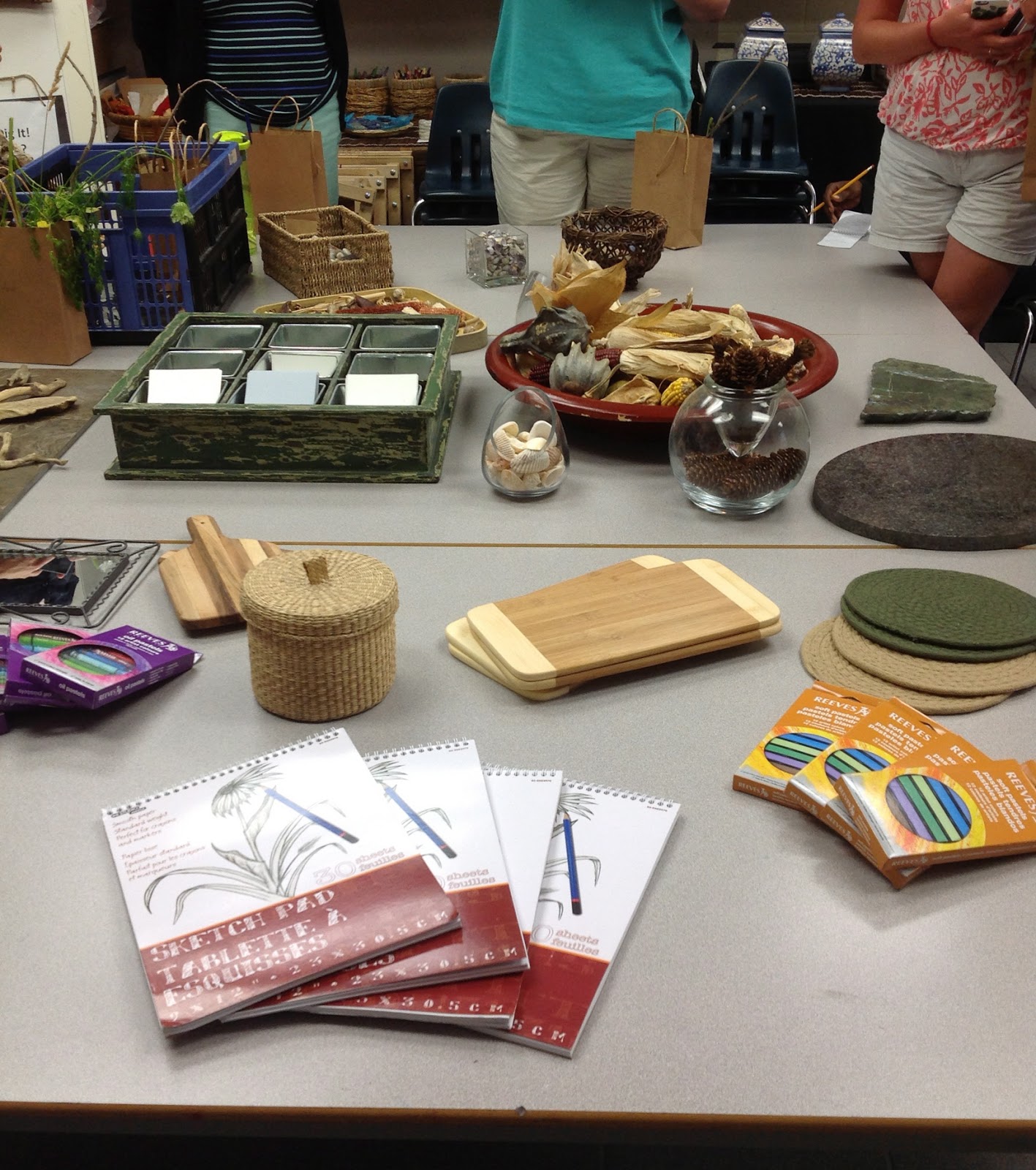
After lunch together we gathered in the art studio or 'atelier'. The wealth of materials in that room instantly impressed me. Everyone seemed to let out a gasp upon entering to see our first invitation to play: tables laden with art materials and loose parts, shelves bulging with jars, works in progress, and materials to touch. Walls covered with beautiful creations and provocations such as the lovely books above. We each found our little brown bags with the natural materials we'd gathered on our walk that morning, and soon we would be invited to use our found items with the materials present on the tables to explore the elements of design: line, texture, colour, form, rhythm, balance, and more.


Before we burst open our bags and pored over the goods all around us, though, Louise brought out a book to share. I couldn't help but smile, because it was the artist whose works have inspired me since I first learned about him in teacher's college many years ago. I've written about his inspiration several times now. Andy Goldsworthy's ephemeral art work features natural materials in outdoor environments. His explorations of the features of water, ice, grass, leaves, stone, wood and more often seem impossible when first looked at. It is his ability to awe that leads me to use his works as provocations for my students, and when playing with adults in exploring loose parts art. His materials also often leave no trace, so when the moment is gone, so is the experience. This type of work, the process being valued over the product, is the reason his creations always seemed so subtle and yet so outrageous to me. His works have oft-repeated forms (spirals, concentric circles, parallel lines, waves, sharp edges) that show up in an amazing array of natural materials, some arranged so poignantly that one can't help but wonder at the audacity of the artist to try something so difficult. I felt a connection to the activity, the book, and indeed to Louise as she explained her reasons for sharing this particular artist. 

Louise smiles as she finds another image to "wow".

Thus inspired, we participants opened our gift bags and began to explore the materials anew. The room took on a hush as everyone got deeply involved in creating something beautiful. Most chose to work alone, but as Julie and I had gathered together we chose to work together. We found a particularly inviting stump on which to work, and there we created our multi-sensory mandala. Once finished, we looked around at the wonderfully unique creations taking shape all around the room, before moving on to the next invitation, which was to capture in 2 dimensions an image of what we'd made with 3-dimensional materials. Before reflecting on the meaning of this next phase, I'd like to share some of the images I captured. One of the things that struck me as I looked over the tables was that the form of the creation almost always took the form of the chosen frame or backdrop. It seemed as though we each found a frame or a place in the classroom that showed potential, and let it steer the direction of our placement.
*Because I was so enthralled in the task, I didn't manage to see all of the work happening around the room. I am grateful to the Reggio PLC photo sharing, and have credited several photos here when not my own.


Our mandala, ripe with the scents of flowers and nuts, rich with the contrasting textures of soft stones and prickly bark. For me, working with materials involves using all my available senses, not just a visual aesthetic experience.


Reggio Inspired PLC deeply involved in our task.


Photo credit: Helen Chapman

Photo credit: Kristine Brown

Dawna's drawing seemed to me to be even more beautiful, more lifelike, than the sculpture it was based on. Photo credit: Kristine Brown


 This activity made our own learning visible: moving from one way of interacting (gathering outdoors) to another (playing, organizing just so, to create something beautiful) and then drawing (using pencils, markers, charcoal). This was an example of just a few of the hundreds of languages of experience and understanding we have as humankind. In working in multiple languages, we deepen our understanding of the materials and our motivations for using the materials (including choice of framing element). Thinking about how to represent our structures was like thinking about our thinking - reflecting upon our choices again and again made certain we would remember this activity for a long time to come, and be able to relate to why it was so powerful. I understood the poem more than a little better at the end of the day. I especially appreciated that Julie and I worked together, because it made the last step so fascinating: we looked at the same object and yet came up with such different representations. The details I chose to focus on were so different than hers that our results were naturally unique. The way that each work seemed shaped, directed in a way by the placement of materials on a frame (a circular mirror or stump, rectangular board, on the wavy grain of marble, the organic curves of a piece of stone) was once again an echo of that post-modern idea: the way you see is deeply swayed by where it is you are when you look. Your environment shapes your responses to experience. In a very real way, this activity allowed us to interact with our environment. For someone who has long ago given up the idea that each teaching has "one right understanding, one set of right answers", this process was very rewarding to see unfold. 

My picture, on the left, with the emphasis on the concentric circles and the lines within each element of the piece. Julie's picture on the right captured the colours and textures first, including the rich brown background of the stump. By choosing different materials to represent our sculpture (I drew first then added colour, Julie used the pastels straight away) our representations came out rather distinctly.

This activity, on the surface, might seem to be solely an artistic exploration. But that is missing the many languages or modes of thinking and acting we were able to play with on this day. For me, a sensory aesthete, my primary modes of learning were activated from beginning to end. Within our group we had artists (you need only look at their representations to see this!) for whom translating the experience onto paper was not a difficult task. I always feel a bit stunted, like I have two left feet, when trying to capture an experience this way. A camera in my hands, or words, and I can tell you in great detail how I felt. My musical family might share lyrically or melodically. Participating in the activity in many ways, then, allows us to tap into our strengths and also experience new,  less familiar ways to express ourselves.


 I leave off this post with the response I posted on the "Technology Rich Inquiry Based Research" blog post about the course. I read it again this week and realized it captured the elation I felt when I realized how transformational the course had been for me. 

"What you gave us in structuring a week of “messing about” was invaluable. I read above your description of how some participants expressed initial discomfort with not knowing the direction of where the play would lead. What the provocations (instead of “lessons”) do so brilliantly is to allow each player to interpret the meaning and relationship between various materials. This, unlike the PowerPoint or teacher talk, doesn’t trigger cognitive dissonance. I mean, hearing about how to structure your classroom in a way so totally unlike the traditional, perhaps comfortable method can’t help but trigger an emotional response, even amongst educators who embrace a playful day in their teaching. But giving us time to explore, touch, manipulate, talk, create, talk more, and play… is powerful. And then giving time to talk about it together, to reflect of people’s questions and noticings? Such good modelling for how we can do it daily in our classroom. Tying the theory in with our readings during debrief time made the theory come alive.
You all did manage to offer a course while following that most important idea: “nothing without joy”.
I’m sure I’ll read this again and see more, but for now, I just wanted to thank you again for a wonderful week. I feel very much at home with my ReggioPLC".