Last week I began to tell the story of why ice has meant so much to the learning journey in our class this year and over several years. Before I sat down to write that post, I'd spent much of the weekend exploring the magnificent ice formations growing along the shore near my home, because the temperature at the time was in the -20 range with windchill values nearing -40. The deep freeze continued this week in school, thus we had several days indoors when the extreme cold meant outdoor recess was cancelled. By Friday, I couldn't wait to get outside and see the shore again. This weekend we've had snow, so much that the landscape is mostly white with trees, rooftops and field covered in white. Nearby Etobicoke Creek still flows under thick ice but it's nearly impossible to see.
The beach disappears as the deep cold (-39 windchill) freezes waves into undulating shapes on the shore.
This crack was the only sight of the wide creek rushing below the ice and snow.
Back in the warmth at home, I thought about how our students got to where we are now, thinking deeply about how we learn. The year began with learning about our
bodies, including our own "Best Part of Me" book. This is our first year of FDK at Thornwood PS, so there was new learning for all of us: the returning senior students who'd only had me for half-day Kindergarten last year, the new junior students for whom all school was new, for my wonderful teaching partner Pooneh who was new to Peel Board (and who I wrote about in a previous post), and for me, learning to share the learning with a teaching partner. We weren't sure what inquiries might develop early on, so we both spent time getting to know our students through shared play and through group invitations. Much of our first month was spent outside, using a skill the seniors remembered well: "looking closely" at our environment to learn about what lives in our schoolyard. As our class began to settle into the new routines, Pooneh and I often split our large group into two, each taking half of the students to do a smaller circle exploration of materials or a read-aloud. Her ECE expertise was quickly evident to me as she created many sensory invitations to hone in on understanding particular parts of our bodies and our traditional "five senses".
This book inspired us to create our own book of our"best part" pictures and stories.
From there we rather naturally moved into health,
both body and mind. Perhaps because so many of our inquiries flowed out of ongoing explorations, much overlap has occurred from project to project. Current inquiries such as body balance certainly link back to that first month's look at our bodies and what we love to do. The ongoing ice projects are certainly about the mysterious properties of frozen water and other materials through the lens of scientific exploration, but a secondary aspect of the long interest in one project is the way some students are developing metacognition about learning, perspective, and ideas. Ice continues to motivate deep thinking and joyful engagement in our class. In part 1, I shared my own fascination with water in winter, and then how #iceinquiry began to unfold this year in class
in late fall. I left off with a collaborative inquiry between our class @109ThornKs and my friend Kelly Wright's class @KinderWonders which inspired our students to incorporate colour into their designs. Kelly had continued to explore this with her class during that last week of school in December. What delighted me was to see how our collaboration was inspiring some pretty incredible thinking among her students as well.
We have been discussing how our brains develop through inspiration, sharing our thinking and technology. pic.twitter.com/p4RPtl6rsH
— K1 Wonders (@KinderWonders) December 22, 2014
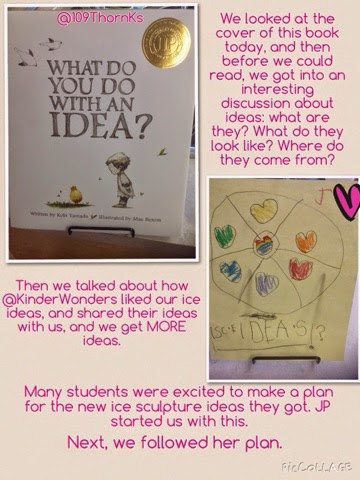
This spark happened right before the winter holiday break. I wondered as the holiday began if the interest in ice projects would fade away, with gifts of new toys and movies seen with family sure to bring new ideas to our conversations. Not ready to move on from the exciting observations about ideas and learning that came up when our students commented on @KinderWonders creations, I brought a new book to share when we returned in January. The funny thing was, we didn't even open the book and read it, because the conversation that flowed once we looked at the cover was too rich! We saved reading to allow the students to share all the ideas bursting forth.
The story was captured in tweets by both myself and my partner Pooneh, as we share the @109ThornKs twitter stream. See the exciting week that unfolded when we asked: "What are ideas and how do we get them, anyway?" Note: some collages included in the slideshow are repeated in this post, as reading the small print can be difficult in the embedded storify below.
Lime ice - a sensory delight that scented the room.
Drawing plans and preparing sculptures for the freezer.
Now seemed a natural time to explore ideas, thinking, and inspiration. The collages below (also included in the storify slideshow above but repeated here for larger viewing to read the print) represent an attempt to capture all the new directions our body and mind, and our ice inquiries were going to expand. When I look back at this documentation, I see what I was missing back in 2010 when I directed the students to all do a drawn and written response to our ice experiment. These days, I try to always let students know that next steps come from them, while ensuring time to reflect on what has happened and to ask questions generating new ideas. This has allowed me to see the students as capable learners whose curiosity and insight is the most important resource in planning experiences.
What emerged from the conversation about "ideas" was incredible: thanks to the spark shared by JP at our welcome circle, the new way for students to create sculptures included drawing (and writing) detailed plans including the materials and tools needed for the project. When so many plans were drawn and created we ran out of space in the freezer, a space on the board was created, dedicated to "tomorrow's projects". It wasn't yet cold enough outside to use the yard for our ice projects. That would come soon enough. We also spun off into studying "brain food" due to the comment "fish is good for our brains", which lead a small group of students to join Pooneh in the library to conduct research into brains and ideas. On another level, we were learning how to conduct research, looking closely at information texts to glean what we could from words and pictures. This skill is one that our students will carry with them for life, and it emerged (as it often does) from deep interest in a topic that arises during a class conversation.
The emergence of several new inquiries in our class in January (including a fire truck project sparked by the local Fire Fighters' visit to our school and an interesting look at gender and identity through toys) meant that the ice projects went hiatus for a few weeks. The learning thus far would have been enough for me to conclude that it was one of our biggest inquiries of the year. When it reawakened, however, the excitement surprised even me. Our collaboration grew to include several classes and teachers whose communication with us helped our ideas grow. Indeed, the word "inspire" became a concept that spread to all we do in room 109. But that is a story for another post.
Our "outside welcome circle" is a time spent singing song, reciting our poems, listening to bird songs and other sounds around us, and noticing life all around us. This week our focus also extended out to the sky.
This week began differently than the last four weeks, by virtue of the fact that our "visitors" (in fact caterpillars which emerged as painted lady butterflies) who'd so enchanted everyone were now all gone. (click here for storify version of the visitors). The last of our resident butterflies had been released into the dandelion-filled long grass in our beloved "no-mow zone" on the Friday. After everyone was gone, my afternoon partner Sanchita and I removed the large gauze tent where the butterflies had been fluttering and feeding on fragrant foods all week. The "visitor" centre gone, along with my recent removal of old documentation from bulletin boards, now the room seemed much emptier. I wondered what interests might fill the space.
The Sundog
The week also began differently due to an unfortunate and mundane occurrence: a water pipe break on the upper floor on the weekend meant arriving early at school on Monday to discover a crowd of school staff gathering outside the entrance, awaiting details and permission to enter the premises. As information came in from the various staff working hard inside to contain the water, we soon realized that while school would be open, several of us would not have access to our classrooms, including the entire Kindergarten team. Thankfully the damage was minimal this time, mostly pertaining to ceiling tiles and bulletin boards along the internal wall of our classrooms, though carpets also got wet. The teamwork was inspiring, with help arriving from all around our family of schools including our wonderful Superintendent who jumped right in to help out. Our side of the pod had dry, clean washrooms and a water fountain easily accessed from the K-yard, so we knew we'd manage.
The storify embedded below contains the tweets sent from my class on that sunny, magical day, as well as the following day when our new inquiry began to emerge.
During our "play and learn" time when students choose where to explore and whom to work with, individual or small group interests were still playing out: ramp-building with various materials, "body balance" challenges with big blocks and planks, mandalas with loose parts such as flowers, beach glass, and stones, and drawing labelled diagrams at the "look closely" table. Each day when we met as a whole group, however, whether inside under the large chart poem or outside under the sun, the same ideas kept coming up.
Several students (strong readers) noticed my error in the first line. I decided to leave the poem this way as a discussion point and it did lead to several mini-lessons about spacing, best work, and when to let an error go (such as when you love the artwork you made to illustrate the poem!)
In the true spirit of adventure, when we first set out for our meeting under the blue sky, I had students grab our grass mats, I grabbed my iPad and a copy of the poem, and we were off. What I hadn't anticipated was such a rich conversation that I would want to record - every word - and that I'd need my usual clipboard because I'm simply too slow with the iPad and outdoor recording is a bit difficult to hear upon replay. While I remember clearly the emotions that rose and the ideas that bubbled up all around our circle, I regret that I was unable to capture all the rich conversation of the morning session (though happily I managed to get quite a bit). So naturally when the afternoon class (like their AM class before them) picked outside meeting time, I grabbed a clipboard and tucked it under my arm before heading out to the front of our school where the lawn is shaded by plenty of mature trees. Somewhere between our door and the lawn, I lost the pen. Yet again, the conversation was so fascinating I was torn between sending a student to the office for a pen and simply being in the moment with the ideas bouncing between children and being rephrased. I chose to stay. This circle being on the front lawn and not out on the meadow, however, meant it was too noisy with traffic and the nearby train for me to record clearly. I did, however, learn my lesson. In the past when a huge interest has emerged and then trickled away before I could harness it (with provocations: books, video clips and/or materials to further the questioning) I simply let it go.
This time, with the sun shining down so brightly and the poem as our anchor each day, I decided to invite students to come speak to me during play and learn over the week. I told them I would like to interview them about their ideas. I wanted to get these ideas down while the topic was still fresh, and also while the students were practicing the poem (before it goes home in the weekly home reading folder). It was remarkable, and I'd like to share their ideas with you.
Sunlight filtered through the trees at the park.
My original question to my students as we met out on the grass was: do you think the poem makes sense? What do you think happens to the sun when you go to bed? I'm thankful that I thought to press "record" and just let our conversation flow. I managed to capture over 5 minutes though not all of it was audible. Here's what I was able to transcribe. I was asking a student to clarify his thinking as I pressed record. Please forgive the confusion, we have many students whose names start with M.
Me: "What's happening at night, then? Can you explain it to us?"
E: "There's one half, bright side of the earth, and one half, dark side of the earth. The dark side is night time and the bright side is day time.".
Me: "Did everybody hear what E said?"
All: "Yeah, yes".
Me: "So it's not that the sun is sleeping, it's kind of like the people on the dark side are sleeping. I like the way you described that. Now M, you said the sun stays, and you also said that the moon, what does the moon do? Show me what you're thinking".
M: "Okay, I'm going to be in the middle, and everyone is going to listen".
Me: "Sure, that's fine. What would you like to say?"
M: "There's one half of two, because the earth is in the middle, and that makes two halves of one (she claps her hands together) - one half morning, one half dark"
Me: "Right..."
M: "...and the half of morning makes the sun awake because it's always bright on that side"
Me: "And what happens on the other side?"
M: "On the other side it's always dark, but the moon shines its bright colour, so it's always awake too. And also, the earth moves to the dark side to make it night, and the moon doesn't sleep, we sleep!"
Me: "The moon doesn't sleep, we sleep. I like the way you said that".
M: "The sun doesn't sleep, we are awake and the sun is awake".
Me: "So, some of the poem is correct? Now M, let's let M tell, I see he has a thought to share".
M: "With the earth, they think to the sun that its day time, and when the earth says: "I don't want the sun to shine" and he faces to the moon, but sometimes he gets in-between, that means the moon right there is over there"
Me: "So the moon is doing something different than the sun. Interesting"
The next student is quiet and interrupted by children talking about a bee buzzing by. I interviewed him another day as I couldn't make out what he said.
Me: "This poem made people think really deeply about the sun. I love it. M, (a girl again) what were you thinking about?"
M: "I think that maybe when the sun goes down, it doesn't go to sleep, it goes under a lake when the sun sets".
Me: "And how does it get back out again?"
M: "Slowly rises".
Me: "That part reminds me of the poem: the sun gets up (everyone joins) in the east..."
(recording ends as another insect discovery breaks our focus and we follow that instead).
Here are the morning students responses for the one-on-one "interviews" on Thursday and Friday. Not all students came to see me for "an interview" though several watched with interest when their friends spoke to me.
Me: "What happens when it gets dark? What is happening to the sun?"
D: "Sun goes down, sleeps with the stars. Why does the sun always sleep? All black, because we sleep".
S: "Not sleeping" (she meant the sun is not sleeping when she goes to bed).
A: "It flies (at night), goes east - the earth is moving - the sun is on the other side, not sleeping".
M: "The sun doesn't go to bed, it's getting up in the east - the sun is like the moon at night".
M: (demonstrating the motion of the sun and moon circling the earth with his hands) "The sun doesn't sleep. No, wait it sleeps and the earth and the moon comes up and blocks the sunlight - so the moonlight is stronger - it blocks the sun from shining - it takes out the sunshine, takes all the shine for itself so it's dark again".
R: "The sun doesn't sleep. In the night the moon comes - the sun doesn't sleep, it doesn't have eyes! It goes somewhere else. I don't know where".
K: "The sun goes to sleep - to an island and down to the sea.
H: (At night the sun is) "hiding".
U: "Shining all the way". (shook his head "no idea" when asked why we don't see it).
A: "The sun is far away. I think it goes to all the other planets - they're friends together - now he (the sun) not sleep - our planet is always awake (too)".
M: "One side of our planet is morning, and afternoon, and night" (she models this showing different times around the earth). "The sun - I heard about sunsets - the sun goes in the lake - it sleeps in the water. Night has arrived. So the poem is true!"
J: "I don't know - hide and seek - comes back".
I was so struck by the knowledge underlying these responses: students had ideas about the planets and moon in motion, about moonlight and sunshine, about time of day and possibly even eclipses, judging by M's ideas about the moon blocking the sun. I didn't want to lose the momentum before the week was through and we moved on to a new poem, so I made myself more available to the afternoon group (by not joining in at various explorations as I normally do) and as such was able to interview all who wanted to share their ideas with me.
Here are the afternoon students' responses. What stands out to me is how the original (not captured) group conversations have shaped the ideas in each class. See a different picture emerge in terms of their understanding of what's happening at night.
A: "It goes down to another country - Canada gets dark and the moon comes up, and the sun goes around".
A: "Maybe it goes where the grass is - it has to be dark - the sun sleeps at home, and in the morning it goes up".
G: "I see the sun up (points through the leafy branches overhead). At night - the tv has sun, too".
J: "The sun goes to another country, it makes it shine, then the moon comes, then the moon goes to another country and the sun comes back".
C: "When I go to sleep I see the sky is pink and blue and yellow and then I see the moon. I think the sun sets, it goes to sleep".
N: "It goes to the end of the world and then the sun sets - like colourful. It hides - maybe it turns into a moon, or maybe it turns around". (she was thinking as she spoke, revising her theories)
S: "The sun turns into stars only at night, in the morning the stars turn into the sun - they make a big sun altogether and in the morning they split up again. Maybe when the full moon goes down it's grey but in the day it's yellow.
J: "Dark - the sun goes does and the moon goes up. The sun goes down, down, down below - it goes pink then dark. The pink and purple sky goes down, too".
D: "Maybe the rainbow is going up because it's night - and the sun changes to a moon" (I ask if the sun changes shape like the moon does, with full moon, crescent...) "Maybe - no, sun is round?"
A: (hearing his friend he had to add on, he was the first quoted above) "Sun is always round - the moon changes".
Z: "Night-time the sun goes down and goes shining to another country, like Pakistan. Pakistan has day, we have night - Pakistan has night, we have day. The sun is closer (than the moon) so you can see it bigger".
F: "It's always gone (at night) - it goes to bed".
M: "It gets down to the grass. (why dark?) Because we go to sleep, it gets tired, it goes to sleep".
D: "Gone - sleep".
A: "It can go down when it's night and when it's morning it gets up again - it goes west - shine somewhere else. It's always shining".
A: "Moon - night, day too. Sun - never at night - sleep".
J: "It disappears (the sun) - it goes down at night".
It was hard for me to record all of these ideas without clapping my hands together in glee. I did, however, mention to my team all week that asking about the sun had given me great insight into my students' thinking and wondering.
I am still digesting the ideas shared by Suzanne Axelsson during her "The Art of Listening" talk at Acorn School last month (click here to see storify of that day); a big take-away was the fact that students are "knowledge thirsty" and capable of philosophical thought at a very young age, but need the time and space to listen and to be heard. While I haven't yet developed the level of listening amongst students where whole group discussions like this are possible except with the most provocative, exciting topics, I do see the value in uncovering students' so-called "wrong" ideas about the world in order to help provoke them to discovering or realizing their mistakenly held ideas. I wonder if the students who seem to have a more nuanced view actually do understand it the way they explain it, or if they've read books or seen movies that talk about how the moon rotates around the earth, for example. Ideas about ice, water, balance and motion are much more easily developed through natural, purposeful play experiences. The sun and daylight, however, is experienced directly and yet indirectly. Naturally I hope to take all these ideas and provoke deeper thought, through experiments, reading stories, more questions, and finding ways to invite cognitive dissonance which is the point of real, deep learning.
Ms. Duric engaged in shadow exploration with her class in the K-yard this week: first they traced her outline, then had to direct her back into alignment with their drawing so I could take a photo. Lada gently prompted her students ("now what do I do next? Can you tell me what to do step-by-step?" and I marvelled at how it made them slow down and work together. I wonder if our inquiries will overlap.
So here I am, wondering what will become of our big ideas next week. I think many of my students will engage in discussing our inquiry at home when they read the poem in their home connection "Friday Folders". I can't help but wonder if some students will explore further, with books or online research done with their families. I am excited by what has come up so far, and I will share their words (or perhaps read the other class's comments instead) at an upcoming meeting. My next step is to do some research, to find resources to further expand our knowledge and look for other classes, perhaps older grades, with whom to correspond and gather new ideas. If you are interested in corresponding with my students via @FynesKs or have suggestions for us, please leave a comment below.
This story began early in April and was first shared, in part, on the "Looking Closely Collaboration"
project blog. It took a while to revisit the inquiry unfolding here
because it involved not just me and my students, but also an integral
player who was a part of our class two days each week: "Daniel days" as
we came to know them in room 109. I have invited Daniel to add any
comments or aha's here as well, when he is fully finished his exams and
adjusted to his status as newly-graduated ECE. The story below is taken
verbatim from the original "Looking Closely" post, followed by an update from the next week when we revisited the provocation and documentation with the afternoon class.
Since writing that post I finished a book I'd been reading on and off for a month, one I'd bought at a wonderful "February Flurry" Early Years Conference at Mohawk College in Hamilton. The author Susan Stacey was both the keynote speaker and the host of my first session of the day. Her stories resonated deeply with me that day and her book was no different. What happened was that I saw my experiences, both positive and negative, clearly framed in the chapters of "the Unscripted Classroom". I could see where I had given up on an idea too soon, or where I could have supported students to solve a problem I rushed in to solve. I also saw that I had learned and grown from my early inquiry days, so that the inquiry detailed below felt like another turning point in my practice. Each chapter begins with a meaningful quote. The quotes pictured below both seemed to capture the delicate balance of a teacher in an emergent curriculum classroom, one I try to maintain daily.
This profound quote sums up the learning journey of the teacher better than anything I'd seen or heard before.
Here is the original story, followed by the update:
We have been so fortunate as a class to have our ECE candidate Daniel
Kerr (@DthedudeK) join us twice weekly. He is a natural teacher in an
early years room: curious, patient, calm but enthusiastic, immediately
engaged in the play of any group he joins. I have adored watching how
quickly the students adopted him as their own; indeed the day his
professor came to visit us she wasn’t immediately able to find him upon
entering the room, so immersed were we all in our various inquiries
throughout the busy classroom. I worry sometimes that guests entering
this noisy, joyful place might see chaos, but she was delighted to have
children come tell her about their play explorations, and eventually
find Daniel deep in discussion with several students in the light
centre. He adeptly takes anecdotal notes (on our ever-present
clipboards) or documents learning on the fly (with the class iPad)
including involving the learners in creating pic collage stories to
share on our class twitter.
A big idea I hope to impart (whether to parents, special guests, or
valuable long-term additions like ECE or teacher candidates) is that the
direction of the learning is always negotiated with the learners in the
room. This means continually changing plans, adapting centres or
materials to support new directions, and letting go of ideas we adults
have when the students come up with better ones. It is the change to my
own teaching practice that has had more impact than any other, including
removing “must-do” activities from our daily schedule, relaxing rules
about how many may use a centre, area, or toy, indeed even how furniture
is used. Another way to say it: I have actively tried to stop saying
“no” to ideas, even those that sound implausible. Once students know the
basic rules of the room (we expect respect for learners and learning
environment) they are able make many choices each day (during our ‘play
and learn time’) without hearing the words “no” or “stop”.
So it is I bring up the story of water music.
A few months ago I brought out the provocation pictured at right during
our weeks-long celebration of Chinese New Year. It’s a simple set I had
at home: a small china teapot (lid not pictured here) with five china
cups, a metal tray, and a dozen or so chopsticks. This was quickly a
favourite place to pour, chime, splash, tap a rhythm, and refill the
teapot from the sink. I also shared a musical provocation in the form of
a short video of a beautiful piece of music performed entirely on clay
pots and china. The performance became the soundtrack to our play and
learn time for weeks as students simply clicked “replay” every time the
music stopped. Daniel and I both noticed wonderful connections being
made by the students to water: how it dances (when the water-filled tray
is played like a cymbal), how the pitch changes depending on the amount
of water added to each teacup, eventually how to lower pitch by adding
water (that discovery made me dance with glee because it was worth the
wait for students to discover what we adults knew but didn’t want to
teach), how much water could be added before the green tray overflowed.
A while ago I dug out some water glasses I had bought over the
summer, expecting someday to use them to make a water-glass xylophone
like the ones I had seen on Pinterest and in friends’ classroom photos
on twitter. They had been languishing in my cupboard because too many
good things were always happening in the room already: interesting
artifacts gathered on walks entered play, or toys from home, or created
toys such as the hand-built “beyblade” spinners. Daniel was looking for
materials for his next provocation, and somehow the idea of the musical
glasses came up. I gave him the set of 6, still boxed, and shared an
image I’d seen of colourful water glasses along with markers and paper
to record musical ideas. He made up plans for how to introduce it the
following week when he returned to our class.
A rainbow of colours by our rainbow of paper. Next step: to introduce to the class.
Daniel sets the scene. Doesn’t that look inviting? Let the music begin!
Now this is where it got interesting. A few years ago I might have
considered what happened next to be a failure: a failure to explain the
task or game, a failure to follow instructions. Now, I see it rather
differently. I was surprised, and also a bit disappointed, when the
sound of tinkling water glasses (so lovely!) was soon replaced by the
sounds of water sloshing into glasses, and children saying; “ooh” and
“ahh” at the spectacle of new colours appearing in front of them. Hmmm.
Where was this going?
Our “potions” (the clear jars mixed up a
few weeks back in a colour-mixing experiment) were quickly brought over
to join the glasses, and the order rearranged to play with new ideas.
Note the clipboard where Daniel had begun to demonstrate ideas to record
a tune. Photo by Daniel.
See here how pouring is becoming the focus
of the activity, with colour mixing and quantity both holding interest
for the various students who come and go. Markers are used to compare to
the “potions” and to inspire new mixes. Photo by Daniel.
Now much of this rich talk is being
captured by Daniel. Another ongoing inquiry has developed into a line
exploration collaborative poster and I am there, capturing the talk and
taking pictures. I was engrossed for a while and completely missed the
spark that turned a musical invitation into a colour exploration. This
is what is wonderful in a classroom of engaged learners: once students
follow their interests and have developed the social and emotional
(self-regulation) skills to direct their learning, I am able to flit
from area to area or sit down and join in the fun. September isn’t like
this, but spring is wonderful!
Even our line collaboration becomes a
celebration of colour. I stay a while before visiting the other area
that’s abuzz with excitement.
Here a girl takes a picture of the array
she has made with a friend. I love how she captures both the subjects
and their reflections. Photo by A.
Now the pouring began in earnest: “Ooh,
look what happens when we add these two colours together!”, “It’s dark
like this one (potion jar)”, “What is this, brown?” See also how the
chopsticks (intended as drumsticks or mallets to play music) have all
become stirrers, and the clipboards for drawing out ideas have been
forgotten.
Magnifiers are brought to look closely at
the mixtures in the jars and glasses. It is now beginning to get rather
messy here, and materials are getting wet. Some students are concerned
about the spills, while others are too focused on their inquiry to take
time to notice the water. When I come over to investigate, I am torn
between continuing the mixing and cleaning up the water that has now
spilled onto the floor and is getting quite close to the building area
carpet. After talking to the students at the table, we agree that this
table isn’t quite perfect for pouring experiments because our spills are
not contained. We clean up for home and plan to improve our area
tomorrow for more exploring. Photo by Daniel.
The next morning is mostly spent outdoors,
and reflecting on how much time was needed the day before to really
explore this invitation, we reserved the water music for another day.
When the PM class returned, we gave the water music idea another try.
After consulting with the students who had experienced the messy spills,
we came up with the improvement you see below: use a tray! We kept the
mirror behind the glasses, and I added the stirring drum, again
wondering if this might suggest musical exploration. You may notice from
the image below that there is music happening (one girl is striking the
glasses with the mallet) but also something new… today we started with
clear water, but the colour idea was too strong so students came up with
this (brilliant!) solution: add markers and stir. I didn’t want to say:
“no” but was stuck by the thought that markers might never be safe in
our class again. Our compromise: we tested all of our markers! The new
ones with bright colour were recapped and left for art. The dried-out
markers were all brought here to test. This included sorting, comparing,
negotiating (“This one’s red, we don’t have any other red”, “How about
brown?”).
New potions are created, with surprising results as the colours darken over time.
Here S happily transitioned from making
music to testing the new colours achieved by adding the dry markers to
the water. We all agreed that the new colours were beautiful and not
just like the original marker they had come from. Interesting!
The delightful result of following a
student inquiry. Saying “yes” really does help us get to know how
creative and capable our students are.
I loved the way the students surprised us
with their ideas. I have to say I was also relieved that Daniel saw the
resulting direction as interesting and worthy of following, not as a
failure. Now, looking back on the learning, I wouldn’t have wanted to
change a thing. However, I wonder what might happen now if I share my
wondering about this with my students: if we tell them we loved their
ideas but were also a little bit disappointed that we didn’t follow
Daniel’s original plan, would this lead to a new attempt, and some
discussion of what is a worthwhile idea to follow? I wonder…
Now here I wish to share what happened the following week, but also to add some sights and sounds I was unable to add in the original post, as I wasn't able to embed the videos in the other format. From the first day when the provocation was introduced: how music gave way to colour exploration:
(note: click on the speaker icon for sound: I've set it to silent due to the distracting noise that occurs when embedded vines play non-stop. Click again to silence).
The next clip is from the second day, when the students requested both a tray to contain spills, and markers for rehabilitating.
I resisted following up on the interesting developments on Wednesday, instead enjoying beautiful outdoor exploring weather and focusing on a few of the other ongoing inquiries each day. In our planning for the following week, Daniel and I discussed revisiting the musical glasses through pictures and documentation. We decided that even though the morning class had taken interest in the artifacts and experiments left out overnight, it was the afternoon group who had taken ownership of the project and thus it was their class we would bring the discussion to.
We showed several images (simply scrolling through the original blog post and our class tweets) and talked about how we had planned for music but that we liked how the students were following their own plan so well. Then we brought up that this time we could come up with an idea together, using the materials we already had to whatever use most wanted. This was an interesting process! Here are as many of the ideas as I was able to capture during our meeting time at the carpet.
(Looking at the projected picture of the water glasses set up to play music)
C: We had to pour the water to make the sounds.
A: I know, let's do it again.
Ms. Fynes: What will it sound like?
Z: The big red one will be deeper. (The red glass is fullest, and least full is reddish too).
D: No the little one will be deeper.
(Looking at the picture where the potions have been added and puddles appear)
J: We spilled it on the floor.
A: It was spilling.
J: It was mixing: blue and green and red and yellow.
(Looking at the picture of the glasses on the tray with markers inside)
J: Oh! There's a lot of colours.
S: You put the tray there so if it spilled it didn't go all over.
(Looking at the picture with the clipboard where S tested the wet markers)
S: We put them in water and tried it.
Z: It looked like paint! The lines are bigger.
S: The small marker makes small lines.
J: The big ones made a big line.
C: They made a splash.
R: First we put water in and then we add the markers.
Next, after looking at the photos and discussing, we asked the students what they would like to do today, if given the same materials: 6 glasses, water, colour, sticks, trays, and whatever other materials or tools they wished to explore.
S: We could use water, music, and colour.
Ms. Fynes: I'm not sure I understand what you mean!
S: First we could make music. Then we could pour water, then we could use colour.
(several students objects to this, wanting to use for one or the other right away).
Daniel: Should we split the cups?
J: Different cups, yes.
J: I want to do the markers.
C & S: We used the "dead" markers (referring to those markers that had dried out).
A: I want to use water beads.
Ms. Fynes: Water beads in the glasses? Where would you use them?
A: In the water table! That's where the water beads are, right?
To help move the conversation along, as we'd been at carpet longer than usual and because I wanted to help every voice be heard, I drew all six cups on the white board. At this point I put my clipboard down so I don't have a record of what was said, however it took a few moments of growing frustration among students before "N" came up and started circling the cups I'd drawn, dividing them up to give two cups each to three different groups Daniel had recorded: music, markers, water beads. We were set!
N helped us divide the glass cups evenly between three centres. Students congregated where they wished to play: water beads in the water table, testing markers on a tray at the writing table, making music and pouring water on another tray.
What I learned on this day was that it wasn't necessarily important that the eventual play didn't last as long as we had envisioned (in fact two groups left for snack and moved on to a balance inquiry project elsewhere in the room), but that revisiting the pictures and talking about what went right and "wrong" the first time (students identified the spills as something to avoid, something wrong) was valuable even for those students who hadn't participated in the explorations on one or both of the days the week before. Students were able to assess the photos, ask pertinent questions, and identify possible problems, simply by looking at what their classmates had done.
Another valuable take-away for me was simply the power of students self-documenting their inquiries. I have joined Suzanne Axelsson's "Through the eyes of the child" project this spring and I'll soon be reflecting with the students which of their photos capture the story they want to tell to an international audience. Though we haven't yet chosen our photos, using this lens has made me aware of the importance of looking at the photos we share, on twitter and in the room.
A girl takes a picture of the project that started as an invitation to make music with water glasses, but quickly took a tangent to revolve around colour mixing, pouring, and "potions". Here she documents the process before adding more materials.
One of the wonderful additions to my ongoing PD journey has been the creation of the #ReggioPLC twitter chats, biweekly on Tuesday evenings at 9. These fast-moving conversations are nimbly led by the wonderful hosts Louise Jupp and Diane Kashin, whose thought-provoking blog posts and Reggio-Inspired Summer Intensive course grew my practice and my PLN exponentially. (see last August's posts for reflections on the wonder that was their inaugural intensive course, and see here for details about this summer's course). One theme that comes up often is the idea of welcome "cognitive dissonance" after these brain-stretching conversations about pedagogy, understanding students, documentation, and more.
I understand the reason people keep calling it cognitive dissonance: it does sometimes feel as though my brain hurts after a good hour of challenging my own and others' ideas. Such speed, like watching professional ping-pong, these concepts get bounced back and forth and tangled into our own stories and argued through various viewpoints. I don't, however, think it is dissonance for me. That would be uncomfortable, leave me feeling like I had been wrong, or mislead, in my thinking. Instead, I think what happens is that a light goes on, and shines on ideas I hadn't quite seen fully. I see more pieces of the puzzle, as it were. I see a bigger picture.
The light bulb has become visual shorthand in my class this year: when someone has an idea, they often run and stand under this light bulb on the chalkboard, as I did here when something a student said at meeting time gave me a big idea (and another student took my picture).
In my last post, I examined the history of celebrations as curriculum in my own teaching practice over the last decade (which I've had the good fortune to spend entirely in Kindergarten). I was nervous to share my conflicted feelings about using certain holidays as teaching topics, because I know many great teachers whose classrooms are full of learning and who do celebrate every holiday with true Kindergarten gusto. I didn't want to leave anyone with the impression that I judge others for using popular cultural days for material for teaching: if anything, I wanted to explain my reasoning for why I often don't but really have no set rule. I argued in that post about the meaning of St. Patrick's Day, an old religious holiday
long since stripped of its religious meaning in popular culture, (though not in that of my Northern Irish in-laws for whom it is a day full of music and lively celebration) now a day full of
single-use, disposable celebratory cups, decorations and wearables. I
shared my discomfort with the waste, the teacher-created crafts that
students merely follow in step-by-step manner to create a product (thus
minimizing the valuable process of the creation), and the lack of
connection to the big ideas in our kindergarten program. Royan's comment after the post sums it up better than I did in so many paragraphs before:
"I certainly don't have any answers, but one question I usually ask
myself is, "Is the [fill in the bank] celebration externally driven, or
is it something the students in my room deeply want to celebrate for
intrinsic reasons?"
So it is I'm back with a provocation that stopped me in my tracks, one
that I instantly saw as creative, brilliant in its invitation to play
with materials. I would use this with my students without reservation.
I'm grateful to MG for letting me quote her class twitter here.
This morning's challenge. Can you make this craft? No instructions, lots of problem solving and working together! pic.twitter.com/vJ0vrEypvD
— K1kinders (@ridgeviewk1) March 17, 2014
@KinderFynes - awe thanks! Stimulated some great talk, they had so many great ideas and worked together. We def. had some "shamrock" experts
— K1kinders (@ridgeviewk1) March 17, 2014
@ridgeviewk1 It would make a wonderful doc panel or picture story 4 families: what is a provocation? How can a craft teach thinking skills?
— kids connect (@KinderFynes) March 17, 2014
There is the lightbulb moment: not dissonance, for it doesn't undo previous thinking, but instead brings it clearly into focus. In this invitation students are challenged to look closely at the form in order to find a way to reproduce it. Creativity is not stifled, but called upon. This is what our kindergarten program asks us as educators to do, throughout all the strands in all areas: identify what children know or need to know for what they are focused on, and extend their thinking with good questions and provocative materials.
What I love about the ever-growing PLN on twitter is how often an idea shared by other educators (Teachers, ECEs and others in this group) connects with interests I've seen in my students, or the way glimpses I've shared on my class twitter resonate for others. Sometimes I catch these stories mid-way, once they've already been taken up by the students in a class. The example below is one that stood out this week: a simple game (one I know as "snap" or "war") becomes a complicated ritual, a spectator event, a reason to record scores, and all student-led. I'm grateful to Kristen Enfelis(@KEnfelis, DECE in FDK) who kindly allowed me to share this conversation:
(I jumped in here too, hence the answer to both of us below).
@bookgirlkpr@KinderFynes using cards 1-10 and 2 players, flip over one card in the middle. Flip remainder of card deck over and 1st 1/2
— Kristen Enfelis (@KEnfelis) March 30, 2014
@bookgirlkpr@KinderFynes child to say "higher" or "lower" gets that card! record results at the end to see who has more/less cards 2/2
— Kristen Enfelis (@KEnfelis) March 30, 2014
There was a student-initiated project shared this week, too, one that helped me appreciate more keenly the role of the educator in an emergent curriculum classroom. This was shared by Nancy Niessen, a teacher who has inspired me greatly with her outlook on teaching through her thoughtful posts. So often since I joined twitter (a mere year and a half ago) I have found myself nodding along to Nancy's musings or observations from her classroom. Being a half-day Kindergarten teacher in Ontario is being a part of a rapidly shrinking group, one with no more members once the last schools like our come into FDK next year. Her additional insight as an AQ instructor for ETFO for the Kindergarten Specialist always make for rich conversations in the #ReggioPLC.
In fact it was Nancy who inspired me to begin a second account for my class this year (and from there to convince the rest of my Thornwood team to follow suit). I have learned much from seeing the way Nancy shares with her family followers on her class account: how to invite conversation between students and their families (with photos of books read and the prompt: "Ask me about...") and how to make student learning visible in a way that truly celebrates the students' efforts. This example below is only one of many such celebrations.
A student brought something made at home. We wrote instructions together, & then the next day he helped his peers... pic.twitter.com/YlhtgpqiR9
— Nancy Niessen (@World_of_K) March 28, 2014
@KinderFynes Yes, pretty amazing. Fortunately, there are many teachers in the room...not just the adults!
— Nancy Niessen (@World_of_K) March 28, 2014
Seeing materials bloom into different projects is a clear indication
that students have ownership over the direction of their learning. Nancy is an exemplary model of a teacher who listens closely and provides direction for further learning. I thank her, as I want to thank all of my inspiring PLN, for daily enriching my thinking, and my learning.
I have many people to thank, including my students, for helping me move my practice towards a more celebratory, creative place for all learners. And so I invite you to look for people who help you see, whether a better reflection of your own practice or a clearer view of the big picture in education.
A first week afternoon class welcome meeting: singing songs, making friends, dancing, watching for butterflies.
This year has been a wonderful, exciting, busy time in our class. It started before the students came back, when we teachers learned about the impact of the big flood in July. Our school was flooded, the first floor left with silt and mud, and as such, our carpets destroyed. We teachers were grateful to those who worked so hard after the flood to clean the school, but we were also concerned. New carpets were ordered but would take several weeks to arrive. What seemed like an insurmountable problem ("How can we have carpet time if we don't have a carpet?") instead sparked something new, something quite wonderful for us in room 109. I purchased roll-up grass mats, the sort you take to the beach. My teammate and friend Ms. Croft brought in large foam tiles to create a soft square for seating in her class, and gave me a stack too, which was a lifesaver on rainy days when we couldn't head outside for meeting time. But for all the other days, the beautiful, sunny days of early September, we started our day together outside in the meadow beside the "no-mow zone". I don't think I've ever had a September quite like this in my ten years of teaching Kindergarten. Goodbye tears disappeared quickly each day as we tramped off over the grass to find a spot to lay down our mats. We greeted each day with our "jumping song" and the butterflies and dragonflies buzzed around us as we sang and danced together. We chased and captured insects to view, and later release. When we entered the classroom after meeting time, it was time to explore and play, freeing me up to spend time with new students on their first days. Relationship building is the most important part of any Kindergarten classroom in September, so this ability to enter the class and move directly to "play and learn time" (the students' chosen name for our free-choice exploration time) has made creating a classroom community much easier this year. I wonder now if all those years, starting out our day at carpet was difficult for nervous new students, surrounded by inviting materials and toys and yet not allowed to touch them while we sat in a circle, all close together.
A welcome circle during the first week, before all new students had arrived. Morning class looking at dragonflies which flew in circles over us and then into the long grass area behind us known as "the no-mow zone".
Last year when I started this blog, I was well into the year with my students and had seen several inquiries build and wane by the time I chose favourites to share. Now since the beginning of this year, intent on forming relationships and building the social structures a class needs, I've watched as friendships were formed around shared interests: three friends creating a track for trains, six friends creating a bey blade arena, five friends catching ladybugs and watching them closely in the "bug jug", four friends exploring colour and shadow in the light centre. Several projects have sprouted and begun to grow (that is, explorations that grow and sustain a group of students for more that a week). One theme has tied them altogether, even though the children's interests are quite diverse. We have a way to explore our learning environment that helps us focus and learn more, by helping us to slow down and truly understand what we are learning about. We call it: "Looking Closely".
A favourite story shared outside: it invites the reader to look very, very closely to discover new wonders in nature.
Now I didn't know this would be our guiding principal. Last year, when I was brand new at Thornwood and all my students were new to me, I made an effort to keep in touch with Miss Metcalfe, the previous teacher in our classroom. Her JK "caterpillar" students, now my SK "butterflies", loved to hear about their teacher in her new school. This was one of many connections we made to classes outside of our own over the year. Making connections was the big idea that connected our projects. It allowed us to share our inquiries with others on the "We Can See" project blog, and saw us sharing materials and ideas with friends in other classes around our school board. By the end of the year my students were well-versed in social media sharing and had a concept of an audience who were interested in their learning. I expected that this would continue to be our big idea, and indeed the butterfly students are often the authors of daily tweets to families and followers. However, the intriguing "Looking Closely" collaboration formed this summer.
Beach glass, water- and sand-softened. Marvelous on the light table, each piece unique.
A faraway friend on twitter is the creator of this wonderful collaboration among teachers and classes all over Canada. It began, like many great ideas I've been able to turn into reality in my class, from a conversation among PLN (professional learning network) friends on twitter. Here is how I described it when I first saved the story for friends on twitter using "Storify" to gather the tweets:
It
started far enough back in the summer that I can't find the tweet. I
shared a picture of some beach glass I'd washed, drying in a colander. @HeatherMMcKay asked if it was truly from the beach, as she'd only ever
seen it in stores. I decided right then to continue beach combing with
my kids until I had a full mason jar, and send half of it off to
Heather. (I've gotten good at finding it: sending fourth parcel this
week). My daughter helped pack, write a card, and sorted out her
favourite pieces (she says I'm not allowed to send the blue and red ones, they're
very rare. I always try to sneak one in).
Here is what I saw on twitter
when it arrived: @KinderFynes IT ARRIVED! Thank you so much to you & M. I love it! Can't wait to WONDER with my new Ss & sea glass!
Although I told her the glass was a found "treasure" and therefore had not cost me anything, she insisted upon returning the favour by sending me a favourite book to inspire students. The book, pictured below, is one of a series of "Looking Closely" books which play with perspective and detail to draw the reader in. We were both so intrigued by the idea of using these books to inspire our students to slow down, look closer. (click here to read the "Storify" version of the twitter story) Since that discussion and Heather's creation of the collaborative blog, many students, in Kindergarten and older grades alike, have taken part in a "looking closely" project with their class. Currently there are 30 teams participating and the enthusiasm continues to build!
A quick thank you sent on twitter to let her know I'd received the book, and soon an collaborative inquiry was born.
Excited to spark more critical looking at the world around us, I bought several more books from the "looking closely" series, along with other titles I remembered as inviting close inspection of everyday objects.
In our class, we share our discoveries daily with our class twitter account: Beyond 4walls @FynesKs . Many exciting inquiries have developed around our habit of looking closely around us: followers on twitter can follow the hashtags to see our #treeinquiry and #lookclosely tweets, and several small-group projects have grown to include students in both classes. Our first post on the collaborative blog shared the story of how we look closely in the meadow where we begin our days. Ongoing interest in the little creatures we find in the meadow has lead to several small groups "looking closely at insects" and becoming experts at how to capture and release various insects gently and carefully. Several projects which warrant their own post here are currently underway in our class: looking closely at our adopted class trees as they change with the seasons, looking for circles, cylinders, and other round things, looking closely at insects, looking at structures in the building centre.
Afternoon students looking closely at their class tree notice
several ladybugs among the wind-blown leaves.
Some inquiry sparks burn bright and fast, leading to whole-class
investigations that excite students, but the investigation
may fail to continue in following days. Last week family followers on twitter could surely hear the buzz of excitement when our afternoon class, walking back from a visit to our class tree, found and captured a cricket. The observations and theories from students were amazing, and it was all I could do to keep up while writing their words. It was an incredible day of learning, yet a Friday, so it is entirely possible that interest will be gone when students return after the weekend. I will be sharing this afternoon's investigations on the Looking Closely collaborative blog, once I know if this is a finished story or merely another page in a growing book.
Outstanding questions for me: Will all the sparks of interest turn into big, large group
projects? Does it need to in order to be valid learning? Is it enough to
capture the moment and reflect on it? What skills and attitudes will
"looking closely" develop in students?